
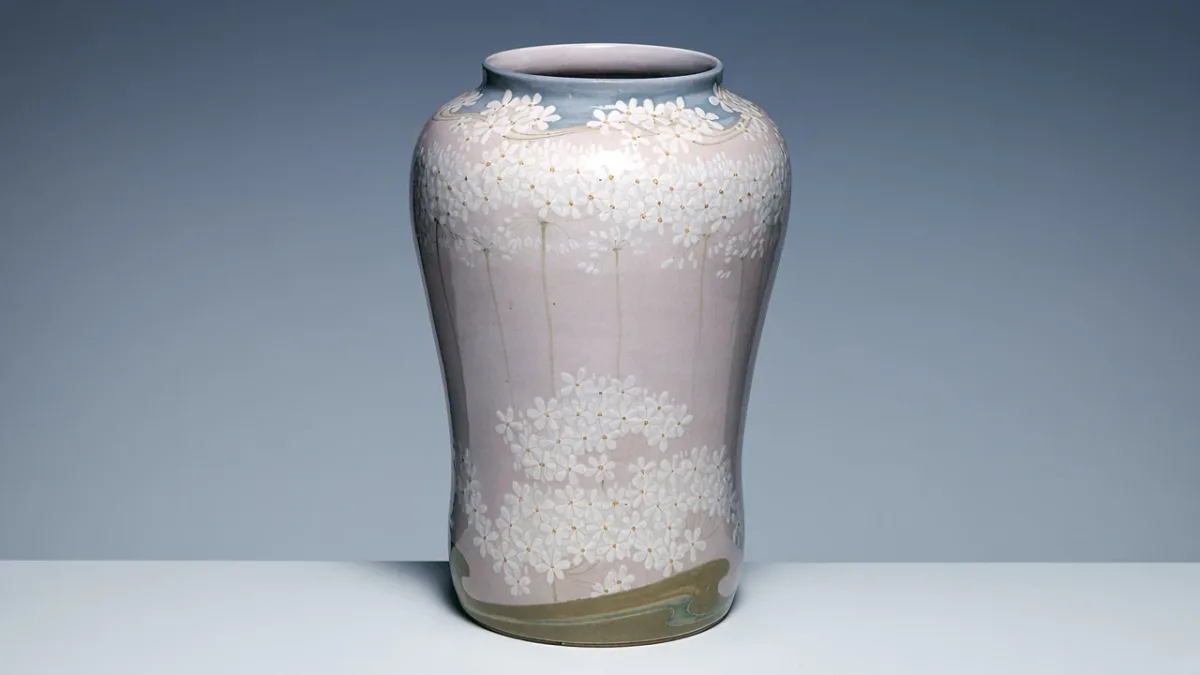
Signs a Galileo Chini Vase Is a Later Copy
How to tell an authentic Galileo Chini vase from a later copy: pomegranate and San Lorenzo grid marks, lustre glazes, and verified auction prices.
Italian Liberty ceramics are a kiln problem, not a style label. The objects that clear at auction were made in a small group of Tuscan workshops around 1900. The workshop that still sets the price is Galileo Chini’s. A later Mugello stoneware pot with a stamped grid is not the same object as an 1898 Arte della Ceramica vase with a modelled female profile and a pomegranate mark. Catalogues often collapse both under one surname. The hammer does not.
Chini (Florence, 1873–1956) was a painter and decorator who ran two successive manufactories, not a porcelain house in the Doccia sense. The first, L’Arte della Ceramica, was founded in Florence in 1896 after Richard of Milan bought Ginori. The second, Fornaci San Lorenzo, opened at Borgo San Lorenzo in the Mugello in 1906. Both made tin-glazed earthenware and, from about 1900, metallic lustre and salt-glazed stoneware. Neither is the Futurist kiln at Albissola, and neither is Lenci’s Turin Art Deco figurine factory. A buyer who treats “Italian Art Nouveau ceramics” as one market pays the wrong band.
Two factories, two marks
L’Arte della Ceramica sat in via Arnolfo, Florence. Galileo directed the decoration. Vittorio Giunti handled the technical side. Giovanni Montelatici and Giovanni Vannuzzi executed. The cousins Chino and Guido Chini joined soon after. The factory mark is a stylised pomegranate (melagrana) enclosing the letters ADC/F, sometimes with Firenze, painted in blue under the glaze or impressed in the paste. The earliest pieces, 1896 to about 1898, add two clasped hands beside the fruit, a device of the founding partnership. That extra mark dates a vase more tightly than a floral motif ever will.
In 1902 the kiln moved to Fontebuoni. Until 1904 the pomegranate is joined by the word Fontebuoni. Metallic lustre and grès appear in the production around 1900. Galileo and Chino then left. In 1906 they opened Fornaci San Lorenzo at Borgo San Lorenzo, named for the town’s patron. The new mark is a gridiron (grata), the attribute of Saint Lawrence, with a stylised fleur-de-lis and the word Mugello, usually painted by hand. Two numbers commonly sit with it: a four-digit code for the decoration, a shorter number for the shape.
From about 1919 the grid sits inside a circle and is more often stamped or incised than drawn. Mugello gives way to Chini e Co, sometimes with Fornaci S. Lorenzo, Borgo San Lorenzo, Italia on export pieces. A diamond-shaped stamp with the same wording belongs to about 1939–1944. The factory was destroyed by bombing in December 1943. Galileo had already left the artistic direction after 1925; Tito and then Augusto Chini, sons of Chino, ran the later kiln. A 1920s Chini e Co mark is therefore a factory mark, not a Galileo autograph.
The Museo della Manifattura Chini, in Villa Pecori Giraldi at Borgo San Lorenzo since 1999, keeps both phases in maiolica, stoneware and glass. The Comune’s Inv. 1 is a useful physical type for the early kiln: a vase about 26 cm high, pale floral Liberty maiolica, marked in blue with the pomegranate, ADCF, FIRENZE and 726, dated about 1900.
Other Tuscan Liberty kilns exist. Egisto Fantechi, Ceramiche Salvini, the Società Ceramica di Colonnata and, in a hybrid register, Richard Ginori itself painted Liberty ornament on more classical shapes. Cantagalli’s lustre sits in a separate historicist tradition. Those names are not substitutes for a Chini mark. They are the field in which a cold-applied pomegranate is sometimes found.
What determines value
Maker and workshop come first, and they are not the same word. L’Arte della Ceramica, 1896–1904, is the scarce early factory. Fornaci San Lorenzo, 1906–1944, is a longer run with a drop in Galileo’s own hand after the Siam years (from 1911) and a further drop after 1925. A pomegranate with clasped hands is an early partnership object. A circular grid with Chini e Co can be a late decorative vase from Tito or Augusto’s period. Both are authentic factory work. They are not priced as one artist.
Period follows the mark. Pre-Raphaelite female profiles, pale grounds and sinuous floral stems belong to the Florence years. Darker palettes, geometric fill, exotic animals and architectural tile logic belong to Mugello, especially after Galileo’s Siamese stay. Deco compactness in the 1920s is still Fornaci work. It is not Liberty, and the market treats it as a later band.
Region is Tuscany throughout. Florence and Fontebuoni are the first kiln. Borgo San Lorenzo is the second. Material splits the price more cleanly than size. Metallic lustre (lustro metallico) is the costly finish: reduced copper and silver stains on tin glaze, technically hard to repeat. Polychrome maiolica on a cream or pale pink ground is the early collector type. Salt-glazed stoneware (grès) is authentic factory output and, for comparable size, the cheaper material. Porcelain is not the Chini story; that belongs to Doccia.
Rarity is of form and of unpublished decoration, not of the surname. The kilns were small. Many models exist in few examples. A large “speciale” vase with a named inscription is not interchangeable with a 17 cm peacock-eye bottle. Architectural tiles from the same grid mark are a different market again, closer to building salvage than to cabinet ceramics.
Condition is read in the lustre first. Rubbed metallic films, overpainted necks, filled chips at the rim and a ring of restoration around a copper mount all print in the catalogue and in the hammer. The 34 cm lustre vase sold in Milan in 2025 was catalogued with defects and restorations; it still sold, at a fraction of an unrestored early parade vase. Crazing in the tin glaze is ordinary. A dead-flat modern spray over an old body is not.
Provenance helps when it is a named Italian collection or an earlier sale with a matching photograph. A retail label remnant under the base is useful dating evidence. A verbal “from a Florentine villa” is not.
Size moves exponentially on the early kiln and on lustre. A 66 cm inscribed vase and a 20 cm 1920s bulb are not two points on one line. Pairs, as in the 1910 lustre vases sold in London, add a further premium that a single later vase does not share.
Market demand is for early ADC portrait and floral pieces, for strong Mugello lustre of good height, and for documented architectural commissions only when the object is still a complete ceramic rather than a detached tile. Later small geometric Mugello ware finds bidders; it does not find the ADC band. These figures are sale results, not a valuation.
Prices at auction
Il Ponte, Milan, auction 622, 28 June 2023, lot 26: Ad multos annos, a large “speciale” vase, L’Arte della Ceramica, Florence, 1898–1902. Polychrome maiolica on a cream-white ground, Pre-Raphaelite nymph, roses and pomegranates, copper rim mount, height 66 cm. Inscribed in blue AD MULTOS ANNOS — L’ARTE DELLA CERAMICA — FIRENZE; under the base SPECIALE 5.357 and the pomegranate with ADC — FIRENZE. Slight defects. Hammer EUR 20,000 against an estimate of EUR 5,000–7,000. The catalogue pointed to Cristina Casali and Valerio Terraroli, Galileo Chini, Ceramiche tra Liberty e Déco (Gangemi, Rome, 2022), pp. 114–117, 135, for comparable decoration.
Christie’s, London, Design, 18 October 2017, lot 167: a pair of Galileo Chini vases, circa 1910, lustre-glazed pottery, 40.7 cm high. One painted CHINI C, MUGELLO, ITALIA, 298/2322; the other with indistinct marks. Price realised GBP 18,750 against an estimate of GBP 15,000–25,000. Christie’s published realised figure includes the buyer’s premium. A Mugello lustre pair of this height sits near the early ADC parade vase, not near later small stoneware.
Il Ponte, Milan, auction 718, 25 June 2025, lot 380: maiolica vase with flowers and three Pre-Raphaelite female faces, Arte della Ceramica, Florence, 1896–98. Relief factory mark and the clasped-hands symbol in blue. Height 26.5 cm. Hammer EUR 5,000 against an estimate of EUR 3,200–3,500. Provenance: E.B. collection, Italy; Manzoni Finarte, sale 26, lot 48, December 1983. The hands date the piece to the first two years of the Florence kiln. Height is modest. The early mark and the portrait type carried the price.
Il Ponte, same sale, lot 371: wide-mouth vase in polychrome metallic lustres with blue crocuses, Arte della Ceramica, Florence, 1898–1902. Pomegranate enclosing ADC F, numeral 370 and letter T in blue. Height 34 cm. Catalogued with defects and restorations. Hammer EUR 3,000 against an estimate of EUR 500–600. Lustre and an ADC mark were not enough to reach the portrait vase sold an hour later. Restoration is priced.
Il Ponte, Milan, auction 668, 5 July 2024, lot 448: bulb-shaped enamelled vase with cobalt, light-blue, yellow and green geometric ornament, two tritons and a flower, Mugello, 1920s. Marked in blue CHINI E C / MUGELLO / (ITALIA), numerals 69/2587, monogram M, and the San Lorenzo lattice. Height 20 cm. Slight defects. Hammer EUR 700 against an estimate of EUR 550–600. Factory-authentic later work. A different band from 1896–1902.
Taken together, the published results support a working distinction, not a price list. Early ADC parade and portrait vases have recently hammered from EUR 5,000 at 26.5 cm to EUR 20,000 at 66 cm in Milan. A restored ADC lustre vase of 34 cm hammered EUR 3,000 in the same 2025 sale. A documented Mugello lustre pair of 40.7 cm realised GBP 18,750 in London in 2017. A 20 cm 1920s geometric Mugello vase hammered EUR 700 in 2024. Spans between those lots are not implied. Architectural tiles, unsigned Liberty ceramics given a Chini name, and lots that failed to sell sit outside this sample. Bonhams, New York, 30 September 2025, offered early double-portrait ADC vases with estimates of USD 12,000–24,000 in the Jason Jacques Collection sale; those lots were bought in. An estimate without a hammer is not a result.
Authentic or later
Start under the base. Photograph the mark in raking light. An ADC pomegranate is a fruit enclosing letters, painted in blue or impressed while the clay was still factory work. Clasped hands belong with 1896–98. Fontebuoni belongs with 1902–04. A San Lorenzo grid with Mugello and two numbers belongs with 1906–19. A grid in a circle with Chini e Co belongs after about 1919. A diamond stamp is late, about 1939–44. A pomegranate on a vase whose shape, dark geometric fill and stamped Chini e Co are Mugello of the 1920s is a warning, not a bonus. Marks and period must agree.
The clay and the glaze are the second test. Early ADC portrait pieces are tin-glazed earthenware with a pale, slightly pooled glaze and decoration that sits in the glaze, not on a cold transfer. Lustre is a reduced metallic film with iridescence that breaks at the rim and in the hollows; it is not a uniform gold paint. Stoneware is heavier, often salt-glazed, with a drier skin. A porcelain body offered as Chini is the wrong factory. Hairline crazing and small kiln specks are ordinary on the early maiolica. A perfectly even modern spray, especially over a ground that has been ground down at the foot-ring, is later dressing.
Tool traces follow throwing and turning. Factory vases of this date are thrown, turned at the foot, and decorated by hand. The interior of the neck shows throwing rings. The foot-ring is wiped. Decoration in female profile and in floral stems is painted, sometimes with slight relief, as on the Museo Chini Inv. 1 vase. A printed outline filled with flat enamel is not that method. Numbers painted in blue under the glaze, matching a known shape/decoration pair, support the mark. Numbers scratched in after firing do not.
Wear belongs where a vase is handled. The inner lip, the high points of relief flowers, and the foot-ring lose glaze first. Lustre abrades in a cloudy patch, not in a neat ring of solvent. A base that is too white, with a mark sitting on a second, poured floor of clay, is a known deceit: a pomegranate impressed into a new plug under an older or foreign vase. Cold-applied painted marks on otherwise ordinary Liberty ceramics, including non-Italian wares, are the more common cheat. The drawing of the fruit is clumsy, the blue sits on top of the glaze, and nothing else about the object matches ADC or Fornaci shapes.
Typical later copies and mistakes: unsigned Tuscan Liberty vases catalogued as Chini on the strength of a female profile; Fantechi, Salvini or Colonnata pieces given an ADC name; Ginori Liberty ornament on a classical Doccia shape sold as a Chini “speciale”; Mugello tiles and small grès lumped with early portrait vases; restored lustre described as “original metallic film.” Buyers who read Mugello as a date, who treat every grid as Galileo’s hand, or who ignore a copper mount that has been reset with new solder, pay for a category the object does not occupy. The parallel problem in Liberty jewellery is the same: a period look is not a workshop. Tin-glaze as a technique is set out in the national maiolica guide; it does not by itself make a Chini.
Serial counterfeiting of this factory is less common than for Gio Ponti’s later Ginori maiolica, because the lustre and the early drawing are hard to repeat. That is not a licence to skip the base. The fakes that do circulate work by moving a mark, not by rebuilding a kiln.
FAQ
Does a Chini e Co mark mean Galileo painted the vase?
No. After 1925 Galileo was no longer artistic director. Tito and Augusto Chini ran Fornaci San Lorenzo. Chini e Co with a circular grid is a factory mark of that later period. It authenticates the kiln. It does not authenticate Galileo’s drawing.
Is metallic lustre always more valuable than painted maiolica?
Not always. The 66 cm inscribed ADC maiolica vase hammered EUR 20,000 without being catalogued as lustre. The restored 34 cm ADC lustre vase hammered EUR 3,000. Lustre is a technical premium on a sound body. Restoration and scale still govern. A small later lustre tile is not an early vase.
Can the two numbers under a Mugello vase be used as a date?
They are shape and decoration codes, not a year. The four-digit number refers to the decoration; the shorter number to the form. Dating still comes from the mark type (hand-painted grid, circular stamp, diamond) and from the ornament.
A professional appraisal or a written condition report is warranted when the mark and the ornament disagree, when lustre has been overpainted, when a second clay floor has been added under the base, or when an object catalogued as 1896–1902 is priced as later Mugello stoneware, or the reverse. Export of important early pieces can also raise heritage questions that a sale catalogue does not settle. None of the prices above is an offer to buy or a substitute for examination in the hand.