
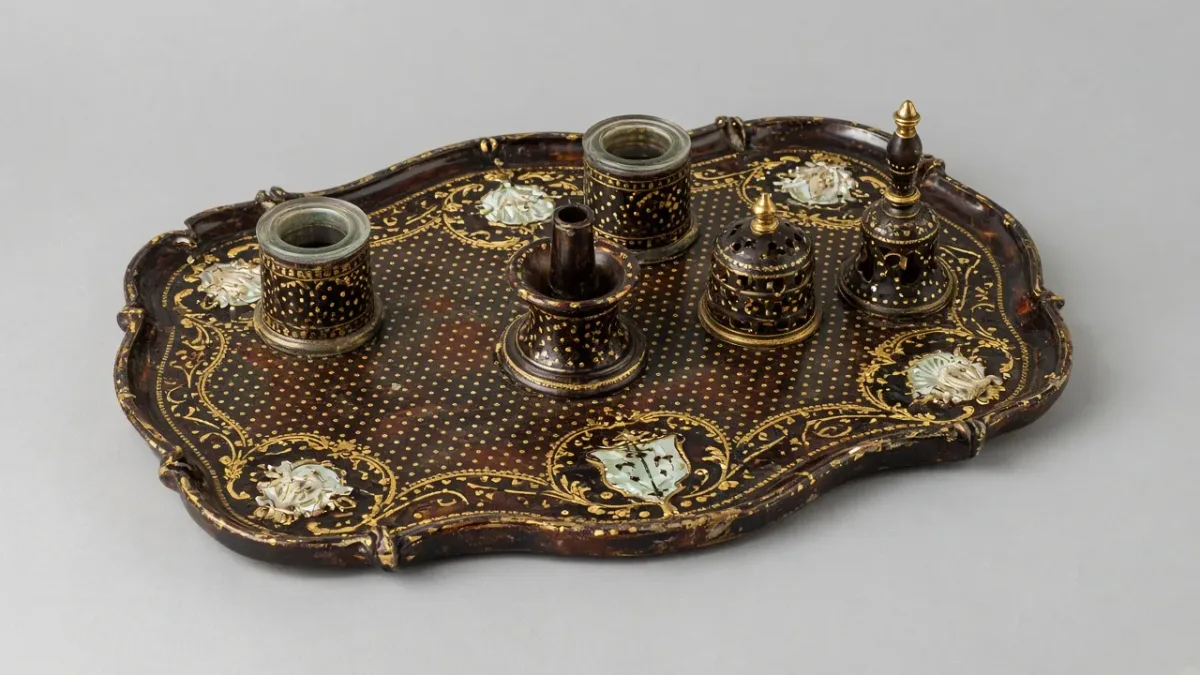
Neapolitan Piqué Workshops of Turris, Sarao and Starace
Neapolitan piqué of Turris, Sarao and Starace: workshop methods, verified auction prices, and how to tell later English copies. Not a valuation.
Neapolitan piqué is not Boulle furniture, and it is not a Victorian brooch. It is tortoiseshell, usually the mottled scutes of the hawksbill turtle, softened in boiling water and olive oil, then inlaid while warm with gold, silver and engraved mother-of-pearl. The shell contracts as it cools and grips the metal. Glue is not the binder. The Italian workshop word is tartarugaro. The objects that still reach museums and sales are inkstands, trays, ewers, dressing sets, snuffboxes, small mirrors and, rarely, tables.
The names that matter on signed pieces of the 1730s to 1760s are Giuseppe and Gennaro Sarao, Nicolas de Turris (who signed Turris F. Neapolis), Nicolaus Starace or Storace, and Antonio de Laurentis. Charles of Bourbon, king of Naples from 1734, and Maria Amalia of Saxony patronised this group. Christie's lot essays cite payments in the Dipendenza della Sommaria accounts. A collector who treats every gold-dotted shell box as "Neapolitan, eighteenth century" is buying a technique, not a workshop.
They sit beside later tortoiseshell veneers on Neapolitan walking-stick handles, and they are a different product from a silver calamaio. The shell is the body. The gold is the drawing.
The tartarugari at the Bourbon court
Catalogues still repeat a late-sixteenth-century Neapolitan origin, later "perfected" by a jeweller called Laurentini in the mid-seventeenth century. Alexis Kugel, in the 2018 Paris exhibition Complètement Piqué, argued instead for a concurrent early-eighteenth-century practice in Paris, the Netherlands and Germany. What is not in dispute is the signed table-object of the 1730s–1760s: a Neapolitan speciality, made by named tartarugari at Charles of Bourbon's court.
Giuseppe Sarao is the name museums use first. A table of about 1730–40, signed in a medallion Sfn for Sarao fecit Napoli, crowded with more than a hundred chinoiserie figures, monkeys, birds and dragons, entered the Hermitage in 1933 after Baron Stieglitz bought it in 1886. Galerie Kugel placed that table at the centre of the 2018 show; the workshop is also recorded next to the walls of the royal palace. Gennaro Sarao, documented between 1731 and 1770 in Christie's furniture essays (Wannenes extends the pair to 1777), continues the same vocabulary of Bérainesque strapwork, singerie and diaper.
Nicolas de Turris signed in Latin. An armorial inkstand sold at Christie's London on 6 July 2006, lot 52, is inscribed Turris F. Neapolis. It is 10 cm high, 24 cm wide and 20 cm deep, with a coat of arms, four Hercules cartouches, two glass-lined pots, a pierced sander and a bell.
Nicolaus Starace (also Storace, Straca in older essays) signed in full. The Fine Arts Museums of San Francisco hold an inkstand of about 1740 (acc. 71.2), inscribed beneath one pot Nicolaus Starace / Fecit Neapoli: tortoiseshell, 24-carat gold and mother-of-pearl, later silver-gilt mounts by Robert Garrard II, provenance through Baron Nathaniel Mayer Victor Rothschild and Christie's London, 12 May 1970, lot 40. The Museum of Fine Arts, Houston, bought in 2018 a related inkstand attributed to Giuseppe Sarao (2018.643.A–.F), formerly at Houghton Hall. The Museu Nacional Soares dos Reis in Porto holds an unsigned inkstand of 1730–35 attributed to the same shop, from the monastery of Santa Cruz de Coimbra.
Antonio de Laurentis was appointed court goldsmith in 1747. A cabinet in the Royal Collection is inscribed DE LAURENZIF F. Whether he descends from the seventeenth-century Laurentini remains a catalogue hypothesis, not a documented genealogy.
Grand Tour traffic is contemporary evidence, not later romance. Robert Adam bought three "very handsome snuff-boxes of yellow and black tortoise-shell studded with gold" in Naples in 1755. Lady Anne Miller, writing from the city in 1771, described a comb "incrusted with gold, to imitate an Etruscan border, copied from an antique vase." The same visitors bought micromosaics and other portable souvenirs. Piqué was the desk and toilet version of that trade. Combs and étuis also overlap the folding-fan market, which used related tabletiers' skills on a different armature.
Alvar González-Palacios mapped the Neapolitan objects in Il Tempio del Gusto. Sir Geoffrey de Bellaigue catalogued the Rothschild group at Waddesdon Manor in 1974 (vol. II, pp. 827–844), including Queen Charlotte's "picay" inkstand and snuffboxes later sold at Christie's in May 1819. Those two books remain the working bibliography; Kugel's 2018 volume is the recent synthesis.
How the shell is worked
The Encyclopédie of Diderot and d'Alembert, in the plates for Piqueur de tabatières, incrusteur et brodeur, separates four operations that catalogues still use.
Piqué (point-d'or): a design is traced on the shell; a hand awl opens a hole; a gold or silver wire is seated in it. Heat from the tool enlarges the hole; the shell closes on the wire as it cools. The worker clips the standing point to the height the drawing needs.
Coulé: the same metals are laid into a groove cut with a burin. The groove opens with heat and closes on the wire.
Incrusté: shaped plaques of gold, silver or mother-of-pearl are pressed into heated shell in a mould, without a separate adhesive.
Brodé or piqué posé: the three operations used together, which is the usual state of a Neapolitan inkstand or tray.
The raw plate is hawksbill (Eretmochelys imbricata; in Italian sale rooms tartaruga caret). Boiling water and olive oil make it plastic enough to join, mould and receive inlay. Once cold, the shell is translucent at thin edges and mottled in amber, tobacco and near-black. Mother-of-pearl on the best pieces is engraved burgau, not a flat white chip. Gold is yellow; later restorers sometimes substitute brass or gilt paint, which neither grips nor tarnishes like the original wire.
Motifs come off French ornament prints. Jean Bérain's arabesques, singeries and chinoiseries are the stock language of the 1730s–50s trays. Ottoman riders, obelisks, ruins and putti appear on the same grounds. A coat of arms, as on the Turris inkstand, is a commission, not a factory default.
What determines value
Maker or workshop comes first when a signature is genuine. Turris F. Neapolis, Sarao fecit Napoli, Nicolaus Starace Fecit Neapoli and DE LAURENZIF F are rare. An unsigned tray in the same vocabulary is still a Neapolitan object of the period if the construction is right; it is not a named workshop. "Attributed to Sarao" is a price category, not a biography.
Period and region follow. The dense, three-material table objects of about 1720–1760, made in Naples, occupy the top of the market. Late-eighteenth and early-nineteenth-century snuffboxes with simpler gold foliage on a dark ground are a different, cheaper class, even when the catalogue still says Naples.
Material quality is visible. Thick, well-matched scutes with a live translucency, tightly set gold points and engraved mother-of-pearl outrank thin shell, sparse pin-work and blank nacre. Rarity is a function of type: a signed inkstand or a small mirror from the Sarao shop is scarce; a 7 cm snuffbox is not.
Condition decides more lots than the label. Hairline cracks at the rim, missing gold points, replaced mother-of-pearl, later ormolu mounts and associated (that is, unmatched) pots are the usual faults. The Christie's inkstand of 10 December 2009, catalogued with later ormolu mounts and restorations, made GBP 5,000. The signed Turris stand of 2006, complete with its bell and sander, made GBP 72,000. That gap is condition, signature and completeness, not a change in "the market for piqué."
Restoration is double-edged. A period repair in shell can be honest. A twentieth-century spray of gold paint over empty holes is not. Provenance still moves the needle when it is documentary: Rothschild, Mentmore, Waddesdon, Houghton. A verbal "from a palazzo" does not.
Size has two markets. Trays of 25–35 cm and fitted inkstands of about 24 cm are the standard collector objects. Monumental dishes over 45 cm with later silver-gilt mounts are a different bet, because the mounts and the shell may not be of one date. Small boxes below 8 cm overlap the gold-box market and are priced as such.
Demand is international and thin. Paris, London and New York still take the important lots; Italian rooms handle more snuffboxes and small mirrors. Import rules for hawksbill (CITES Appendix I in most jurisdictions) shrink the bidder list. A London result is not a price available to a buyer who cannot ship the lot. None of the figures below is a valuation.
The parallel with other southern precious-material workshops is useful only as a warning. Trapani coral mounts also mix organic material, gilt metal and later replacements. Completeness of the original field matters more than the place-name.
Prices at auction
These are published results, not estimates. Hammer is given where the house prints it; otherwise the realised price including premium, as published.
Christie's London, 6 July 2006, Important European Furniture, Sculpture and Tapestries, lot 52. Armorial piqué inkstand signed Turris F. Neapolis, Naples, about 1740, 10 × 24 × 20 cm, with pots, sander and bell. Realised GBP 72,000.
Christie's London, 7 July 2005. Shaped oval bassin, Naples, second quarter of the eighteenth century, exotic scene of a seated woman receiving fruit, Bérainesque border, 6.5 × 33.5 cm. Realised GBP 42,000.
Christie's London, 1 December 2005. Shaped oval dish, Naples, second quarter of the eighteenth century, obelisk and figures, 26 cm wide, minor losses and replacements. Realised GBP 16,800.
Christie's Paris, 4 May 2016. Early-eighteenth-century Neapolitan dish in hawksbill, gold piqué and engraved burgau, obelisk with bust, 30.5 × 23.5 cm. Realised EUR 49,500.
Christie's Paris, 1 December 2016. Early-eighteenth-century Neapolitan dish, gold piqué and burgau, Ottoman woman on a dromedary, later silver-gilt and enamel mounts possibly Löcse about 1740, 50 × 34 cm, some splits. Realised EUR 32,500. The mounts are a separate object.
Christie's New York, 24 May 2001. Pair of Neapolitan gold-inlaid tortoiseshell trays, mid-eighteenth century, Roman buildings in the centres, 30 cm wide. Realised USD 30,550.
Christie's London, 18 May 2016. Gold and tortoiseshell piqué snuff-box, probably Naples, about 1810, later Dutch gold import mark, 82 mm wide. Realised GBP 15,000. A later box, still expensive because the gold work is fine.
Christie's London, 3 July 2019. Two circular gold-mounted snuffboxes, probably Naples, about 1750, each 70 mm, piqué point and posé with rocaille, birds and scale-work. Realised GBP 4,375 and GBP 3,000.
Christie's London, 10 December 2009. Mid-eighteenth-century Naples inkstand with Bérainesque inlay, later ormolu mounts, restorations, 26 cm wide. Realised GBP 5,000.
Il Ponte, Milan, 20 April 2021, sale 503, lot 55. Tortoiseshell and gold piqué snuffbox, Naples, late eighteenth or early nineteenth century, 6 × 3.5 × 5 cm, minor defects. Hammer EUR 4,500.
Il Ponte, Milan, 28 October 2025, sale 732, lot 49. Small shaped mirror, workshop of Gennaro Sarao, Naples, about 1730–1770, tortoiseshell piqué threaded and inlaid in gold, 22 × 18 cm, slight defects, CITES notice. Hammer EUR 22,000.
Bonhams, London Knightsbridge, 28 January 2014, sale 21325, lot 363. Eighteenth-century Neapolitan tortoiseshell and gold piqué dressing set associated with Lady Juliana Penn, six combs, étui and tray. GBP 21,250 including premium.
Ranges follow from those lots, not from a dealer's hope. A signed or firmly attributed Naples inkstand or tray of the 1730s–50s, complete and unremounted, has sold from the mid-five figures in pounds or euros into the low six. Small period snuffboxes of 6–8 cm have sold from about EUR 4,500 hammer to GBP 15,000 realised depending on date and gold density. Restored inkstands with later mounts have sold in the low thousands of pounds. Victorian English jewellery piqué, discussed below, is a different market and should not be averaged into these figures. Bonhams Paris, 14 November 2023, lot 29, a damaged second-quarter-eighteenth-century Naples tray, was offered at EUR 5,000–8,000 without a published hammer on the lot page; it is a condition warning, not a price.
Authentic or later
The first test is construction, not a story about Charles of Bourbon.
Period Naples table piqué is thick enough to take three techniques at once. Hold the rim to daylight: hawksbill shows a mottled, slightly cloudy translucency, not the even caramel of cellulose acetate. Gold points stand as cut wire. They are not identical in height. Under a lens the shell has closed around each point. Painted gold sits on the surface and chips. Brass pins are yellower in a different way and often sit in holes that were opened cold.
Signatures are scratched or inlaid, not stamped on a later plaque. Turris F. Neapolis and Nicolaus Starace Fecit Neapoli appear where a tool could reach, typically under a pot or in a medallion. A crisp "Sarao" on a paper label is a dealer note.
Fitted inkstands should be a set. Pots, sander, quill holder and bell share the same shell colour, the same density of points, and wear at the same high spots. Associated glass liners are common and acceptable if disclosed. Associated ormolu pots, as on the 2009 Christie's stand, are a later assembly.
English piqué of the 1860s–1880s is the usual confusion, not a fake of a Turris inkstand. Handmade jewellery of the 1860s can be fine. From 1872 Birmingham factories produced machine-set piqué: thin shell, often silver rather than gold, rigid geometric or cruciform designs, brooches and buttons. Those objects are Victorian jewellery, not Neapolitan desk stands of 1740. Mixing the two in one price conversation is the standard mistake.
French and German eighteenth-century piqué snuffboxes exist. Kugel is explicit that the technique was not unique to Naples. The Neapolitan claim for a tray or inkstand rests on the three-material Bérain vocabulary, the tartarugaro signatures, and the typology of the fitted stand. A small circular box with gold points and no nacre can be several cities.
Common buyer errors are consistent. Taking "piqué" on a jewellery card as a Naples attribution. Ignoring later mounts. Reading a coat of arms as proof of a royal gift. Assuming CITES paperwork is optional. Trusting a perfectly even, lemon-gold surface on an object said to be 280 years old. Completeness of the original field of points, the match of the fittings, and a signature that can be compared with published examples are the usable tests.
Hawksbill is a restricted species. Auction houses print the warning on almost every lot. A buyer who cannot import the object into the country where it will be kept has not bought a collection piece. That is a legal fact, not a bargaining point.
When to seek an appraisal
A signed inkstand, a tray over 25 cm, or any object offered with a royal or Rothschild provenance should be seen by a specialist in gold boxes and European sculpture, not only by a general furniture cataloguer, and should travel with a written condition report that distinguishes original fittings from later mounts. Tortoiseshell cracks, replaced nacre and emptied pin-holes are easy to miss in a photograph. If the piece must cross a border, the same report should record species and the CITES position before a bid is placed. An unsigned snuffbox of ordinary quality does not need a museum essay; it still needs a close look at the gold and the rim. These prices are records of past sales. They are not an offer to buy or sell, and they are not an appraisal of any object in hand.