
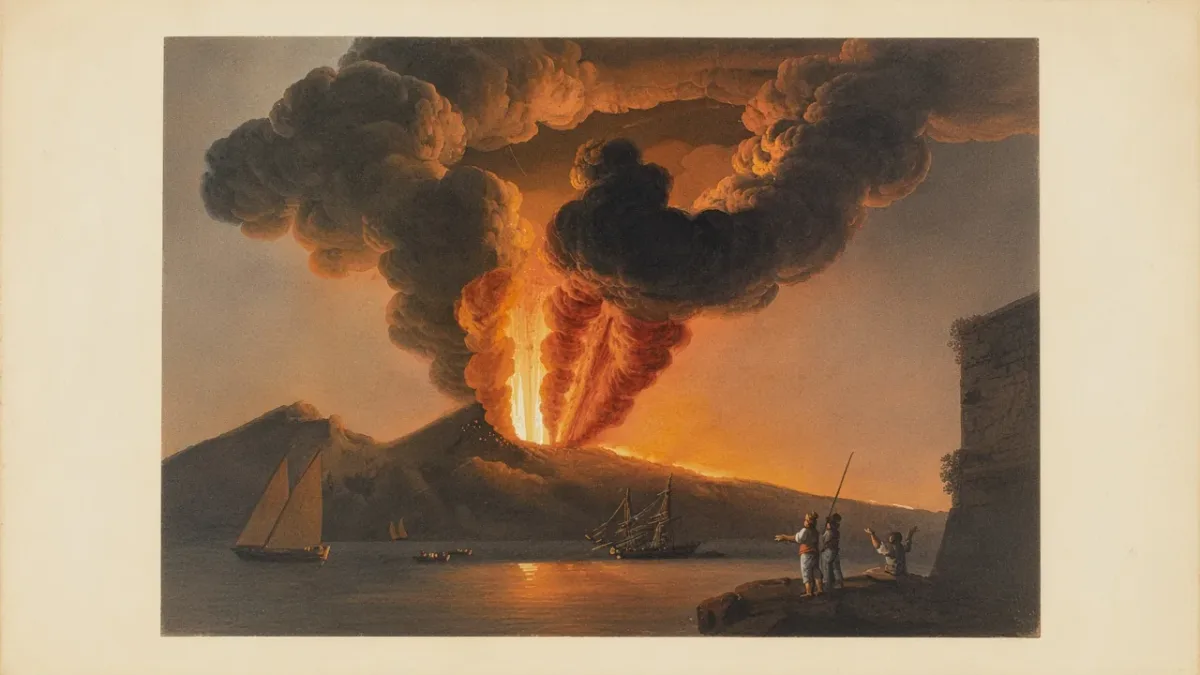
Neapolitan Gouache Worth: Vesuvius Views at Auction
What a Neapolitan Vesuvius gouache is worth: auction prices, Camillo de Vito sheets, and how to tell authentic Grand Tour views from later copies.
A Neapolitan gouache of Vesuvius is a souvenir sheet, not a Posillipo oil. Opaque bodycolour on paper, often with a painted black or grey border and a handwritten Italian title, sold to travellers who wanted a dated eruption they had seen, or one they had missed. The Museo di San Martino in Naples holds more than a hundred eruptions on paper in the Caselli gift of 1957, from scientific plates to Grand Tour vedute. The market for the same objects is split. A signed Camillo de Vito night view in a set can make tens of thousands of dollars. A twentieth-century pair on card, the same volcano, the same orange column, sold at Il Ponte in 2014 for EUR 130 hammer. The gap is not taste. It is authorship, date, size, condition and whether the sheet is gouache at all.
The type sits beside other portable Naples souvenirs. Travellers who bought Neapolitan piqué from the Turris and Sarao workshops or micromosaic plaques in Rome often packed a Vesuvius gouache in the same trunk. Dating Grand Tour antiques by material and workshop still applies. The support here is paper, the medium is bodycolour, and the workshop is a Neapolitan vedutista working to a repeated formula, not a bronze founder.
What determines value
Maker or workshop. Camillo de Vito, documented in Naples in the first half of the nineteenth century, is the name the trade uses for nocturnal eruptions with a manuscript Eruz. line. The Raccolta Stampe Sartori records him as painter, draughtsman and lithographer, active in Naples from 1794 to 1847, specialising in gouache views and night eruptions. Christie's, cataloguing a set of four in 2022, cited Angela Tecce's essay in Gouaches napoletane del Settecento e dell'Ottocento (Museo Pignatelli, Naples, 1985–86) for his prolific output, including views of the 1822 eruption. Gioacchino La Pira, identified by the Istituto Matteucci as active in Naples between 1839 and 1870, signed bay, Capri and Ischia sheets rather than crater-night formula work. The Matteucci note places a Veduta di Napoli da Mergellina in the Museo di San Martino and records that English travellers were directed to him in the 1869 Handbook of travellers in Southern Italy. Saverio (Xavier) della Gatta, active in Naples 1777–1829, belongs to an earlier, more expensive register: large bodycolour views of Portici and Posillipo, sometimes after Giovanni Battista Lusieri, with Grand Tour provenance. Unsigned "Neapolitan School, 19th century" is the default catalogue line. It is not a De Vito.
Period. An eighteenth-century della Gatta, dated in the paint and bought in Naples in 1784, is a different object from a mid-nineteenth-century eruption souvenir, which is different again from a twentieth-century tourist gouache of the same bay. The inscribed eruption year names the event depicted. It is not, by itself, the date of execution. Travellers ordered famous past eruptions as well as the one they had just watched. Bonhams's 2006 De Vito sheet is catalogued as the eruption of 19 December 1820 and inscribed Eruz de 19 Decembre 1830. Treat the caption as a subject label until paper, costume and topography agree.
Region and viewpoint. Standard stations are the bay from Posillipo or Mergellina, the crater from the Atrio del Cavallo, Torre del Greco, Nisida, Pozzuoli, Capri and Ischia. A titled pair of named coastal stations is more useful than a generic "Golfo di Napoli". Night eruptions with a readable town profile are the De Vito staple. La Pira's daylight fishing views occupy a quieter band.
Material. Period sheets are gouache (bodycolour) on paper. Pigment sits opaque on the sheet. Under raking light the lava and the white of a wave have a slight relief. A regular dot screen, a plate mark, or ink that soaks into laid lines is a print, including later chromolithographs of the same compositions. De Vito also worked as a lithographer. A lithograph after his design is not a gouache by him. Italian copperplate views of Rome and Venice are a parallel Grand Tour paper market with different evidence: address line, plate wear, watermark. Do not date a Naples gouache as if it were a Piranesi.
Rarity. Single unsigned eruptions of the 1820s–1830s are not rare. Sets are. Christie's 2022 four-sheet De Vito group and the 2009 three-sheet group, each sheet titled and signed, are the form that still moves the needle. Large sheets (around 43 × 65 cm, or della Gatta's 52 × 76 cm class) are fewer than the pocket 21 × 27 cm pair.
Condition. Gouache scuffs. Night blues, often Prussian, fade and shift. Foxing, waterstaining and losses along a painted border are routine. Sheets laid down on board lose the verso, the watermark if any, and much of the paper evidence. Trimmed borders remove the title band that catalogues use to identify the eruption. Dorotheum's 2014 unsigned view of Naples with Vesuvius, 22 × 27 cm and catalogued as damaged, is the condition discount in public.
Restoration and size. Overpaint in the lava column and a replaced border are common. A "feigned mount" painted as part of the original sheet, as on Christie's 2018 De Vito ERUZ. DEL 1832, is period practice, not later framing. Height is catalogued with or without that band: a 30 × 44 cm De Vito is the usual souvenir size, a 72 × 50 cm sheet is not.
Provenance. A sheet that can be placed with a traveller in Naples is worth more than the same composition without a name. Christie's 1994 della Gatta View of Naples from the Strada di Posillipo, signed and dated 1784, came from Jonas Langford Brooke, who bought it in Naples that winter. Most De Vito and La Pira sheets on the market have no such paper trail.
Market demand. Named night eruptions in sets, and dated della Gatta views with provenance, are the two active bands. Unsigned nineteenth-century school sheets of ordinary size sell in the low thousands of euros at Italian houses when the gouache is intact. Twentieth-century repetitions occupy a souvenir register. The School of Posillipo (Anton Sminck van Pitloo, Giacinto Gigante and their circle) is a separate oil and watercolour market. A gouache souvenir is not a Posillipo painting with the oil cleaned off. None of this is a valuation of a particular sheet.
Prices at auction
Published results, with house, date, description and the currency as printed. Prices vary with condition and with the sale. They are not an appraisal.
Christie's New York, 28 January 2022, sale 19981, lot 52: Camillo de Vito, four views of Vesuvius erupting, bodycolour, 42.8 × 65.5 cm each. Realised USD 35,000 (estimate USD 6,000–8,000). Provenance: Mallett at Bourdon House, London; property from the collection of Gayfryd Steinberg.
Christie's London, 10 July 2009: Camillo de Vito, a set of three, Interno del Vesuvio della notte 27 Marzo, Eruz del 1820 Lava da Vicino and Eruz del 1817, each signed lower left and inscribed with the title, gouache including borders and inscriptions, 30.5 × 44.2 cm. Realised GBP 11,250 (estimate GBP 3,000–5,000).
Christie's London, 13 June 2018, lot 38: Camillo de Vito, Eruption of Vesuvius, 1832, signed and dated Camillo de Vito p. / ERUZ. DEL 1832., bodycolour on a feigned mount, 72.3 × 49.8 cm. Realised GBP 3,500 (estimate GBP 3,000–5,000).
Bonhams, London, New Bond Street, 7 March 2006, sale 13802, lot 9: Camillo de Vito, Vesuvius erupting, signed lower left, inscribed Eruz de 19 Decembre 1830, gouache, 31.5 × 44 cm. Sold for GBP 2,640 including premium.
Dorotheum, Vienna, 2 April 2015, lot 244: Camillo da Vito, The eruption of Vesuvius 1834, titled Eruz. del 1834, signed, gouache on paper, 34 × 30 cm, framed. Realised EUR 4,250 including buyer's premium and VAT.
Christie's New York, 29 January 2015: Xavier della Gatta, View of Naples from Portici and View of the Palazzo Reale at Portici, one signed and dated Gatta f. 1784, black chalk and bodycolour, 51.7 × 76 cm, a pair. Realised USD 118,750 (estimate USD 70,000–100,000). The catalogue relates the viewpoints to Lusieri's 1783–84 Portici sheets.
Christie's London, 23 May 1994, lot 242: Saverio Xavier della Gatta, A View of Naples from the Strada di Posillipo, with Vesuvius beyond, signed and dated Xav.s Gatta. p. 1784., watercolour and bodycolour, Strasbourg lily watermark, 36.1 × 58.9 cm, original mount. Realised GBP 29,900. Bought in Naples in 1784 by Jonas Langford Brooke.
Christie's Amsterdam, 8 September 2009: Gioacchino La Pira, A view of the bay of Naples, signed La Pira lower right, watercolour and gouache on paper, 32 × 44.5 cm. Realised EUR 4,375 (estimate EUR 2,500–3,500).
Bonhams, London, Knightsbridge, 22 November 2022, sale 27488, lot 165: Gioacchino La Pira, Fishing boats off Ischia, signed and inscribed Ischia / La Pira lower right, gouache, 42.5 × 62.6 cm. Sold for GBP 1,275 including premium.
Il Ponte, Milan, sale 653, lot 283, 27 March 2024: Neapolitan school of the nineteenth century, Eruption of Vesuvius, gouache on paper, 43 × 65 cm, carved and gilt frame, defects. Hammer EUR 1,600 (estimate EUR 1,200–1,400).
Dorotheum, Vienna, 28 March 2024, lot 249: Italy, c. 1880, a pair, Isola di Nisida come si vede dai Bagnoli and Veduta della Città di Pozzuoli come si vede dalla Strada de Bagnoli, manuscript titles on a grey margin, gouache on paper, each 32 × 48 cm. Hammer EUR 4,800, excluding buyer's premium and VAT.
Il Ponte, Milan, sale 670, lot 1211, 20 September 2024: Neapolitan school, nineteenth century, two volcanic views, gouache on paper, signed and dated, maximum 21 × 27 cm, frames, defects. Hammer EUR 330 (estimate EUR 220–240).
Dorotheum, Vienna, 30 September 2014: Italy, c. 1820, view over Naples to Vesuvius, gouache on card, 22 × 27 cm, framed, damaged. Realised EUR 875 including premium and VAT.
Il Ponte, Milan, sale 319, lot 920, 1 April 2014: twentieth-century Neapolitan painter, pair of gouaches on card, Vesuvius and the Gulf of Naples, 23 × 50 cm, frames. Hammer EUR 130 (estimate EUR 30–40).
A working reading of those lots, not a price guide: a named De Vito night sheet of ordinary souvenir size has sold in the low thousands of pounds or euros; a titled set of three or four is a different order of magnitude; an unsigned nineteenth-century eruption of similar size sits nearer Il Ponte's EUR 1,600 hammer; a twentieth-century pair on card is souvenir money. Della Gatta in the 1780s, large, dated and provenanced, is the ceiling of this paper market. Sotheby's New York, 30 January 2019, lot 75, a large De Vito CENERI DEL VESUVIO SORTITA LI 26 XBRE 1813 (62.7 × 89.2 cm), was estimated at USD 10,000–15,000. The house page does not publish a hammer. It is cited here as a size and inscription type only.
Authentic or later
Unframe the sheet. Read the border, the caption, the paper and the pigment before the signature.
Period gouaches of the De Vito type carry a painted black or grey band that belongs to the sheet, not to a later frame. The eruption title sits in that band in Italian, often abbreviated: Eruz. del 1832, Eruz de 19 Decembre 1830, CENERI DEL VESUVIO SORTITA LI 26 XBRE 1813. The 2024 Dorotheum pair still had handwritten titles on a grey margin naming Nisida and Pozzuoli. A sheet whose edges have been cut to the image has lost that evidence.
Signatures, when present, are small and in the lower corner or in the title band. De Vito: Camillo de Vito or Camillo de Vito p. La Pira: La Pira, sometimes with the place, Ischia / La Pira or Capri La Pira. Della Gatta: Xav.s Gatta. p. and a year. A flowing "C. de Vito" in ballpoint or a printed facsimile in the margin is not those hands. Unsigned work is the majority of the nineteenth-century school. Catalogues that upgrade it to De Vito on the strength of the night-orange column are guessing.
The same eruption viewpoint was repeated in the workshop. That is how the souvenir trade worked. Repetition is not, by itself, a fake. What is later is the continuation of the formula on machine-made card in the twentieth century, often in a thinner, aniline-bright palette, without an eruption date, sometimes as a pair of "Vesuvio" and "Golfo" in matching frames. Il Ponte's 2014 lot is that class, and it sold as such.
Prints after gouaches are common. A lithograph or a chromolithograph of an 1822 column can look convincing under glass. Take the glass off. Gouache has a matte, slightly chalky surface. Lithographic ink sits in a different film. A plate mark belongs to intaglio, not to a souvenir gouache. Honest reproductive prints usually have a typeset caption outside the image. Dishonest ones rely on the frame.
Paper: European laid or early wove for eighteenth- and early nineteenth-century sheets. Della Gatta's 1784 Posillipo view was on paper with a Strasbourg lily watermark, still on its original mount, with inventory numbers on the reverse. A sheet that is only visible as a card stuck to board cannot be tested that way. Foxing and a slightly cockled surface are consistent with age. A dead-flat, brilliantly white wove on a composition labelled 1810 is a reason to stop.
Topography is a check, not a proof. Torre del Greco, the Granatello at Portici, Castel dell'Ovo and Capo Miseno can be read on a careful sheet. A later copyist working from a print often simplifies the shoreline and enlarges the lava. Costume in the foreground, if present, should match the claimed date.
Common mistakes. Paying set-of-four money for a single unsigned school sheet. Treating the inscribed eruption year as a date of painting. Calling every Naples gouache "School of Posillipo". Buying under glass and discovering a print. Assuming a dramatic night sky is rare. It is the product. A Neapolitan presepe figure and a paper veduta were sold to the same travellers. They are different trades.
The Hampton National Historic Site sheet Eruzione de 13 Settembre 1810 (HAMP 1083), gouache on paper, 53.34 × 77.74 cm, attributed to De Vito, is the museum type: a titled night eruption on a large sheet. Use it as a type. Do not use an unattributed internet jpeg as a signature comparison.
FAQ
How can I tell a Camillo de Vito gouache from a later tourist copy?
Look for opaque bodycolour on paper, a painted title band with an Italian Eruz. line, and a small autograph Camillo de Vito that matches catalogued examples, not a printed name. Twentieth-century copies are often on card, brighter, untitled or titled in modern capitals, and they sell at souvenir prices. The 1822 column is not a signature.
Does a signed La Pira sell in the same range as a De Vito night eruption?
Public lots of signed La Pira bay and island views have realised from GBP 1,275 including premium (Ischia, Bonhams 2022) to EUR 4,375 (Christie's Amsterdam 2009). Single De Vito night sheets of similar size have realised from GBP 2,640 including premium to GBP 3,500. Titled sets sit far higher. The names are not interchangeable.
Is a pair more valuable than a single sheet?
When the pair is period, titled and of matching size, as with the 2024 Dorotheum Nisida and Pozzuoli sheets, yes. A later decorative pair on card is still a pair. Il Ponte's 2014 twentieth-century example shows what that sold for.
A sheet offered as an important De Vito, a della Gatta, or a Grand Tour set, especially if laid down, overpainted, or accompanied by a family story without papers, needs a specialist in Italian drawings and a written condition report before the price is discussed. An unsigned school gouache of ordinary size does not become a De Vito by assertion. The Caselli drawings at San Martino remain the public reference for how many of these eruptions look when they are simply catalogued as paper.