
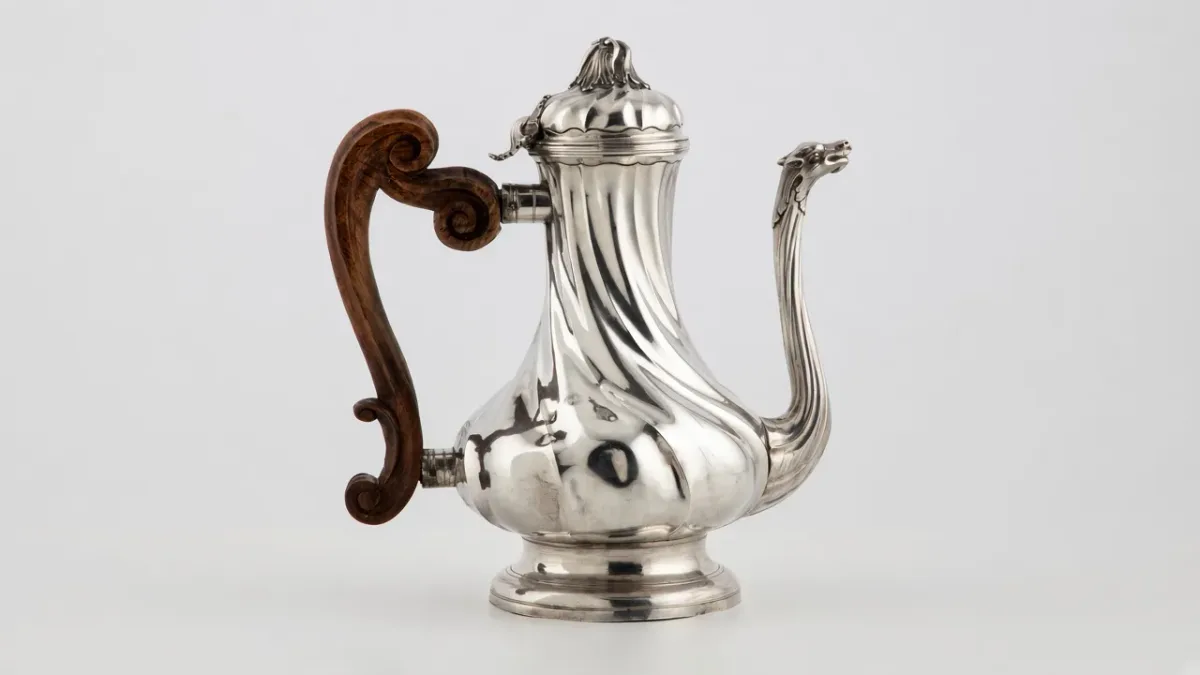
What an Antique Italian Silver Coffee Pot Sells For Today
Auction prices for an antique Italian silver coffee pot, and how Genoa, Venice and Naples hallmarks tell a period caffettiera from a later copy.
Italian inventories call the object a caffettiera: a vessel raised to hold and pour hot coffee, with a hinged lid, a spout and a heat-insulating handle, usually of wood. It is not a matching tea-and-coffee service. A servizio da tè e caffè is a later, complete set. A single eighteenth-century pot is catalogued and priced on its own.
A chocolate pot (cioccolatiera) is a different tool. Its lid is pierced for a wooden mill, the molinetto, that stirred the drink. Coffee pots of the same decades keep a closed lid. Confusing the two is a common cataloguing error and it moves the price.
The market pays for a named city, a readable assay, an unrestored wooden handle and a lid that carries the same punches as the body. It discounts later 800/1000 factory pots sold as “Baroque,” replaced handles, unmatched covers and electroplate. The figures below are auction results. They vary with condition and the day of sale. They are not a valuation.
What determines value
Maker or workshop comes first when it can be read. Giuseppe Balbino of Turin, with the assay of Francesco Pagliani (active 1775–1787), is documented on a large pear-shaped pot with an eagle-head spout now in the Fondazione Cerruti, Rivoli (inv. 0460, cat. A408): 34 × 32 × 18 cm, 1,790 g, shown in 1959 at the Museo Poldi Pezzoli exhibition Argenti italiani dal XVI al XVIII secolo (cat. no. 223, pl. CLXX) and again at the 1963 Mostra del Barocco Piemontese. Most trade pots are not of that rank. They carry a city punch and, at best, an assayer. That is still enough to price them above an unmarked pear.
Period and region are linked. The canonical Italian type of the 1750s–1780s is Genoese or Piedmontese: a piriform body with spiral or torchon gadroons, a circular foot or three scroll feet, a zoomorphic spout and a carved wood handle. Franco Broggero and Fiorella Simonetti, in L’argenteria genovese del Settecento (Genoa, 2007), treat the vegetal handle socket as a point of “vibrating chiaroscuro” against a smoother body (pl. 18, p. 179, a 1765 comparison). Venice preferred a lighter pear with a triangular high-set spout and a lion-in-moleca assay. Naples followed a different legal fineness and a crowned NAP sequence. Rome and the Papal States used cameral punches, then lozenge makers’ marks after the Restoration. A twentieth-century Milanese 800 pot is judged by factory name and weight, not by a turret.
Material is sterling-range silver of the local standard, not plate. Genoa after 1824 used 950/1000 (eagle) or 800/1000 (cross of Saints Maurice and Lazarus) with a dolphin for the assay office. Naples after the pragmatic De Monetis LVII of 19 August 1690 was 833.33/1000 until the French decimal titles of 1808 (917 and 834). National Italian 800 and 925 marks, from the law of 2 May 1872, belong to a later industry.
Rarity is a dated turret, a named master, a Savoy or other documented provenance, or an unusual spout (eagle, griffin, dog). Ordinary unsigned nineteenth-century Papal or Milanese pears are not rare.
Condition is decisive. Dents at the foot, a split hinge, a replaced handle and a resoldered spout are catalogued as difetti in Italian sales and they cut the hammer. Restoration of the wood is expected; replacement of the wood by a later silver handle is a restyling, recorded for example on a Genoa 1775 pot catalogued by Cambi (sale 244, 18 November 2015) as a probable late-nineteenth-century alteration.
Provenance moves the top of the market. The Cerruti pot passed through Christie’s Geneva, Important European Silver, 19 May 1998, lot 129, with a claimed House of Savoy history. Trade lots rarely have that paper. A coat of arms on the cover, as on a Siena pot catalogued by Christie’s, is useful only when it can be read.
Size and weight travel together. Period Genoese examples used in this article sit around 24–30 cm and 850–1,200 g. A 22 cm Venetian pot of 367 g with restorations is a different object from a 30 cm Mantuan pot of 1,000 g.
Market demand is still for the turret-marked Genoese pear and for named Piedmontese work. Nineteenth-century Papal and 800 factory pots sell nearer to weight. Complete twentieth-century services are a separate bid, treated in the tea-set article.
Prices at auction
Verified results, as published. Premium-inclusive figures are labelled as such. Hammers from Il Ponte are the aggiudicato printed on the lot page.
Finarte, Milan, 15 April 2025, lot 137: Genoa, turret punches for 1761, pear body with twisted gadroons, zoomorphic spout, wooden scroll handle, defects; 990 g, height 28.2 cm. Sold EUR 5,160 including buyer’s premium.
Lempertz, Cologne, 16 November 2017, sale 1102 (Klaus J. Jacobs), lot 19: Genoese pear, twist fluting and chased acanthus, floral finial, no maker’s marks, c.1764; 1,118 g, height 28 cm. Result EUR 11,475 including premium. The catalogue compared it to a Genoese pot illustrated in V. Donaver and R. Dabbene, Argenti italiani del Settecento (Milan, 2000), pl. XIV.
Christie’s, Geneva, 15 May 1995: Genoa 1757, spirally fluted pear, bird-head spout, harp-shaped wood handle, marked on base and cover; 1,037 g, height 26.5 cm. Realised CHF 31,050.
Il Ponte, Milan, 28 March 2025, sale 701, lot 860: Mantua, eighteenth century, ribbed body on a circular foot, wooden handle carved with opposed scrolls, defects and restoration to the handle; 1,000 g, height 30 cm. Hammer EUR 3,000.
Il Ponte, same sale, lot 852: probably Mantua, eighteenth century, ribbed body on three scroll feet, defects; 560 g, height 26 cm. Hammer EUR 1,400.
Il Ponte, same sale, lot 855: Rome, early nineteenth century, Vincenzo Contini (1779–1820), ovoid body with lanceolate chasing, ebonised wood handle, defects; 920 g, height 38 cm. Hammer EUR 1,400.
Il Ponte, 5 February 2026, sale 754, lot 486: Papal States, nineteenth century, unidentified maker, plain body, stepped circular foot, ebonised handle, dents at the base; 700 g, height 30 cm. Hammer EUR 900.
Il Ponte, 22 October 2019, sale 459, lot 67: Venice, eighteenth century, ribbed pear, carved wood handle, restorations; 367 g, height 22 cm. Hammer EUR 750.
Bonhams, London, 24 September 2014, sale 22122, lot 238 (Martignone contents): Rome, first half of the nineteenth century, maker’s mark S25S in a lozenge, vase shape on a square pedestal, bacchic putto finial; height 35 cm. Sold GBP 2,250 including premium.
Bonhams, Los Angeles, 22–31 March 2021, sale 27104, lot 74: two Neapolitan neoclassical pots, 833 silver, c.1810–1830s; heights 30.5 cm and 26.5 cm. Sold USD 1,657.50 including premium for the pair.
Dorotheum, Vienna, 4 September 2013: Italian coffee pot, c.1870, maker ABF, Italian assay, hinged lid with a bird finial, side wood handle; 643 g, height 25.5 cm. Realised EUR 625 including buyer’s premium and VAT.
Those lots describe a working range, not a tariff. A turret-dated Genoese pear in sound condition has recently sold in the region of EUR 5,000–12,000 with premium. A restored or provincial eighteenth-century pot at Il Ponte has hammered between EUR 750 and EUR 3,000. Unidentified nineteenth-century Papal and late Italian factory examples sit under EUR 1,000 on the same circuit. A museum-grade Piedmontese or early Genoese piece, when it appears at Christie’s, is another market. Wannenes, Cambi and Pandolfini regularly catalogue comparable Genoese and Roman pots; several of those lots are published with estimates only and are not used as prices here.
Authentic or later
Start with the punches, then the construction.
A period Genoese pot is struck with the torretta, the stylised castle of the city. The Corporazione dei Fraveghi is documented from 1248; the punch remained in use, with changing outlines, through the French département marks of 1805 and the Sardinian annexation until 1824. Year digits in the turret date the object to a season, not to a style. After 1824 the same office used a dolphin plus the Mauritian cross (800) or eagle (950). A pot catalogued as 1760 that carries only a national 800 lozenge is later, or it has been added to.
Venice used the lion of Saint Mark in moleca, usually with an assayer’s initials. The Republic’s punches ran until the French system of 1810–12, summarised by Piero Pazzi and on the BeWeb compilation of Venetian assay. Naples used a crowned NAP, NAPL or NA, with date digits from 1690, then the Parthenope head under Joseph Bonaparte and Murat. Rome used crossed keys under the ombrellino, then numbered lozenges after 1815; a Roman coffee pot of the 1830s–40s should be read against those Papal assay marks, not against a turret.
Punches belong on the body and on the cover. Christie’s Genoa 1757 pot was marked on base and cover. A virgin lid on a punched body is a marriage.
The handle is wood on almost every period Italian coffee pot of this type. Silver conducts heat. A later all-silver handle, a mismatched collar, or a handle whose grain and screw do not correspond to the sockets, is a replacement. The hinge should be original to the cover; a crude later pin is visible from above.
Tool traces of raising remain inside a period body: hammer planishing, not the orange-peel of a sand casting. The finial on better Genoese work is chased from the cover sheet (cimasa sbalzata dalla lastra), not a separately cast knob soldered on. Spout heads (griffin, dragon, dog, eagle) are cast and chased, then let into the body; a blunt solder halo around a thin pressed head is typical of later copies.
Wear sits where the object was used: the thumbpiece, the lower handle collar, the foot ring. Uniform mirror polishing that has taken the punches down to ghosts is a defect, not a virtue. Electroplated copper or Britannia metal with a washed 800 stamp is outside this market.
Typical reproductions in the trade are:
- factory 800 pears of the late nineteenth and twentieth centuries, sometimes with a historicist zoomorphic spout
- Dutch or English pears given an added Italian-looking punch
- chocolate pots with the mill hole plugged and sold as coffee pots
- lids from another city or another decade, fitted to a better body
Common buyer mistakes follow from those types: reading “Italian Baroque” off the silhouette alone; treating an 800 lozenge as an eighteenth-century city mark; ignoring a restored handle on a turret-dated pot; paying tea-service money for a single late factory caffettiera. For the national sequence of Italian silver hallmarks, and for the Venetian lion and Neapolitan NAP and Parthenope series in more detail, the punches on a coffee pot are the same punches used on candlesticks and trays. They are not a special coffee-pot code.
FAQ
How do I tell a Genoese coffee pot from a Piedmontese one?
Genoa is the turret, often with a year, on the foot and the cover flange. Turin and the Savoy assay used named assayers (Francesco Pagliani, among others) and makers’ pictorial punches, not a castle. The large Cerruti pot, with its eagle spout and three scroll feet, is the Piedmontese type at full scale. Many Genoese pears stand on a circular foot with a griffin or dragon spout and a harp-shaped wood handle.
Does a wooden handle mean the pot is eighteenth-century?
No. Wood is the correct insulator on period pots and on many honest nineteenth-century ones, including the Dorotheum 1870 example and Il Ponte’s Papal lot of February 2026. A wood handle with a national 800 mark is a later pot, not a fake. A silver handle on a turret-dated body is the warning.
Are Italian silver coffee pots always marked 800?
No. 800/1000 is the common national title after 1872 and the Sardinian domestic title after 1824. Eighteenth-century Genoa, Venice and Rome were on other local standards. A pot sold as 1750 that is struck only 800 should be catalogued as later.
What is the difference between a coffee pot and a mocha pot?
Trade catalogues sometimes use caffettiera for the large pear and moka or caffettiera da moka for a smaller cylindrical pot. Height and capacity are the guide: the period domestic pear is usually 24–32 cm. A 17 cm twentieth-century 800 pot is a different, cheaper object.
A pot whose turret or lion can be read on body and cover, whose handle sockets have not been rebuilt, and whose weight matches its size, can be dated. One that cannot should be described by what is visible. For insurance, export or a five-figure bid, commission a written condition report from a silver specialist or the auction house that would be asked to sell it. That report is not an offer to purchase.