
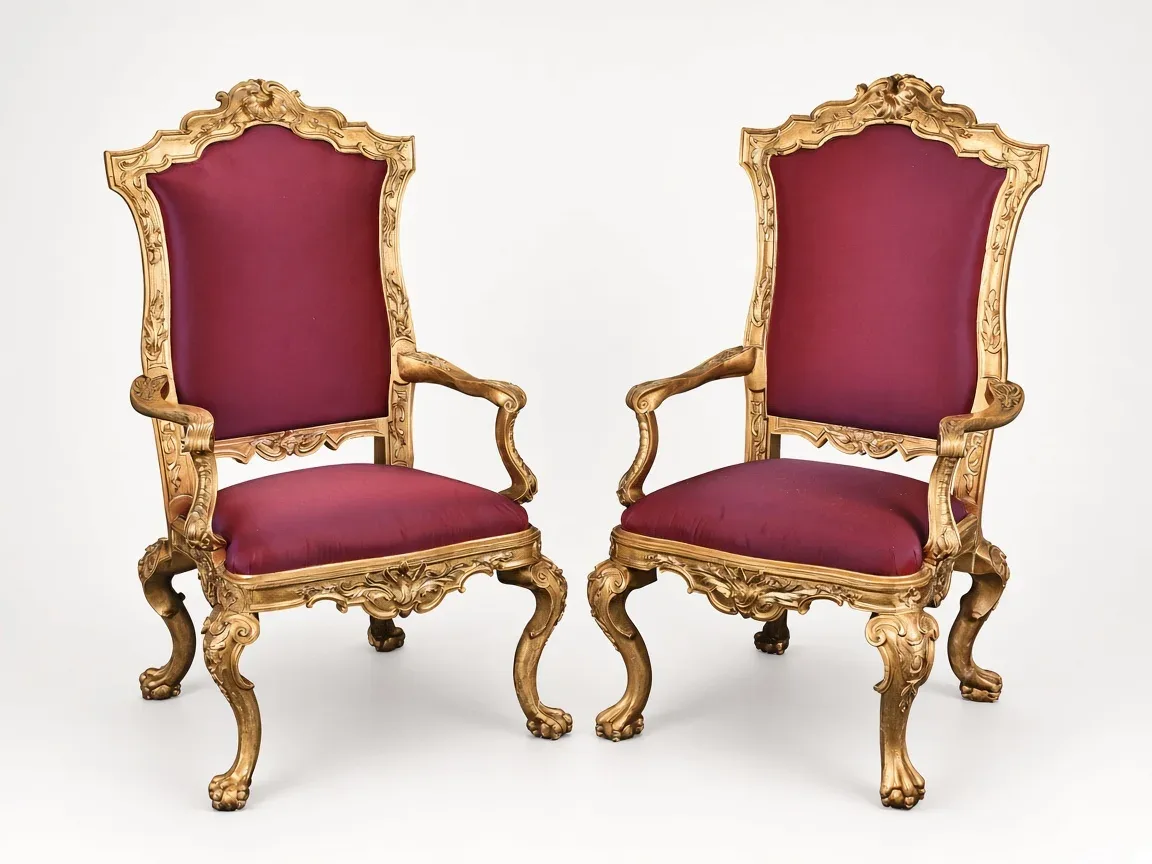
Italian Carved Giltwood Chair Worth: Auction Prices and Later Copies
Italian carved giltwood armchair prices at auction: what drives value, and how to tell an authentic 18th-century chair from a later gilt copy.
The trade still prints “Italian giltwood armchair” as if that were a school. It is a surface. Venetian rococo cartouche backs, Genoese barocchetto with double-scrolled arms, Roman walnut-framed chairs of the 1750s–70s, Neapolitan white-and-gold neoclassical seats, and nineteenth-century copies of all four are priced as different objects. The gilding is the first thing a buyer sees. Construction, city and date are what move the hammer.
The object here is carved giltwood seat furniture: the poltrona, the open armchair, occasionally a matching side chair. It is not about Neo-Renaissance walnut case-work, already treated as nineteenth-century furniture sold as Renaissance, nor about the Ligurian Chiavarina, a light beech chair of a later industry. The same shops that carved giltwood frames in Rome and Florence and pier consoles also made chairs. The tests overlap. The market does not.
The figures below are auction results. They vary with condition, upholstery, completeness of a set, and the day of sale. They are not a valuation.
What determines value
Maker or workshop comes first when a name or a documented palace group can be read. Italian sediari almost never punched a civic mark comparable to silver. Attribution rests on palace commissions, on drawings, and on published concordances. Enrico Colle, cataloguing a pair of Roman giltwood armchairs at Il Ponte in 2011, could point to a Borghese salon still in Villa Borghese and to Giuseppe Morazzoni’s Il mobile neoclassico italiano (Milan, 1955, pl. XI b), and could only hypothesise Antonio Asprucci as designer and an unnamed Roman chair-maker as executant. That is the normal ceiling of certainty. Named carvers such as Andrea Brustolon of Belluno (born 20 July 1662, died 25 October 1732), whose ebony and boxwood Venier suite is at Ca’ Rezzonico, and Giuseppe Maria Bonzanigo (1745–1820) in Turin, sit at a different level. Brustolon’s branch-work seggioloni are sculpture that happens to be sat on. Later workshops copied the ebony figures and the ramaglia. Those copies are a collecting field of their own and do not date a gilt rococo armchair.
Period and region are linked. Mid-eighteenth-century Venice produced the cartouche-backed, cabriole-legged open armchair that catalogues still treat as the type specimen; Saul Levy’s Il Mobile Veneziano del Settecento (Milan, 1964) remains the plate-book. Genoa in the same decades carved a heavier barocchetto, documented by Loredana Canonero, Barocchetto Genovese (Milan, 1962), and by Alvar González-Palacios, Il Mobile in Liguria (Genoa, 1996). Rome of 1750–70 is scarcer. Bonhams, selling a pair in 2023, cited González-Palacios, Arredi e Ornamenti Alla Corte di Roma (Milan, 2004), p. 197, and noted that Roman rococo chairs are difficult to date with accuracy. Turin followed French goût grec and Louis XVI outlines for the Savoy court at Palazzo Reale and Stupinigi; Naples at the end of the century preferred lacquered-and-gilt neoclassical frames with fluted legs. Palermo used doratura a mecca (silver leaf under a yellow varnish) more often than water-gilding, and painted floral seats of the first half of the eighteenth century are rare.
Material is usually poplar, pine or walnut for the rails, with lime or another carving wood for the ornament, then gesso, bole and gold leaf. Venetian frames were also silvered and then varnished, or parcel-gilt over coloured lacquer. A beech or stained hardwood carcass offered as “Roman, 1760” is later or provincial. Upholstery is almost never original. À châssis (drop-in back and seat) is the period construction; a stuffed-over nineteenth-century upholstery campaign on an eighteenth-century frame is common and should be priced as a later skin, not as a later chair.
Rarity is a documented palace set that has not been broken, a pair that has stayed together, or a four- or six-chair suite. Single trade armchairs of ordinary rococo outline survive in quantity.
Condition and restoration decide the middle of the range. Regilding is the commonest alteration. Water-gilding (doratura a guazzo) wears at the high points to a red or yellow bole; oil gilding and bronze paint sit as a cold, even skin over recut or sanded ornament. Replaced arm-terminals, sistered rails, new blocks under the seat, and later stretchers are expected. Active worm in sapwood, missing toes, and a frame that has been opened and reglued without the original tenons drop the price further.
Provenance is thin on most lots. A Borghese, Chigi or Venier inventory note, a Ca’ Rezzonico exhibition label (the 1938 Lacche veneziane del Settecento show remains a reference), or a dealer’s stock book of the Barozzi class will carry a pair. A verbal “from a palazzo” will not.
Size matters less than completeness. A single armchair of palatial height (about 120–130 cm) is harder to house than a pair of 90–100 cm chairs and does not automatically outsell them. Sets of four still find the international rooms.
Market demand currently pays for Venetian rococo pairs with fluent carving and for documented Roman or Piedmontese neoclassical seats. It is weak for unsigned nineteenth-century Baroque-style giltwood, even when the carving is dense, and weaker still for single later copies offered as “Settecento.” The same split is already visible in Italian giltwood mirror prices: period water-gilding and later even gold are not the same column.
Prices at auction
Italian rooms and the international houses price this field in three bands that the lots themselves keep distinct: ordinary eighteenth-century pairs and singles in the low thousands of euros; documented or unusually carved Venetian and court chairs in five figures; nineteenth-century revival giltwood from a few hundred euros to a few thousand, overlapping the bottom of the period band when the carving is ambitious.
Il Ponte, sale 732, 29 October 2025, lot 186, awarded EUR 5,500 (estimate EUR 1,800–2,000) for a single Genoese eighteenth-century armchair in carved, painted and gilded wood, with a rocaille-centred back, scrolled double armrests and scalloped legs, catalogued with defects. The same sale, 28 October 2025, lot 125, a pair of Neapolitan late-eighteenth-century neoclassical armchairs in carved, lacquered and gilded wood, provenance Carlton Hobbs LLC, New York, hammered at EUR 3,000 (estimate EUR 3,000–4,000), defects. Il Ponte, sale 339, 31 March 2015, lot 45, a pair of eighteenth-century giltwood armchairs of serpentine outline, upholstered in cut velvet, restorations, awarded EUR 3,400. Il Ponte, sale 281, 22 March 2011, lot 159, a pair of Roman giltwood armchairs, last quarter of the eighteenth century, 102 × 59 × 51 cm, silk upholstery, from a Borghese salon of which related seats remain in Villa Borghese, hammered at EUR 3,000. Colle’s catalogue note on that lot is the documentary point: even a Borghese association, published by Morazzoni, did not lift an Italian-room pair out of the low thousands.
The international houses pay more when the carving is Venetian and the set is intact. Christie’s, 19 May 2004, a set of four Venetian mid-eighteenth-century giltwood armchairs, cartouche backs, pierced crest-rails, rocaille arms, scrolling cabriole legs, gilding refreshed, realised USD 83,650 (estimate USD 40,000–60,000), estate of Tara Colburn. Christie’s London, 10 December 2015, a pair of late-eighteenth-century giltwood armchairs, probably Genoa, ribbon-twist and beading, fluted tapering legs, 107 × 65 × 56 cm, realised GBP 10,625 (estimate GBP 6,000–9,000). Bonhams London, Fine Decorative Arts, 30 November 2023, sale 28268, lot 60, a pair catalogued as probably Roman, 1750–1770, solid walnut rails, shell cresting, claw-and-ball feet, 74 × 69 × 128 cm, sold for GBP 4,480 including premium. Finarte Rome, 20–21 February 2024, four carved and gilded Roman armchairs, late eighteenth to early nineteenth century, 96 × 62 × 50 cm, oak-leaf and acorn seat-rails, red velvet, sold for EUR 15,210 including buyer’s premium.
Nineteenth-century and later giltwood occupies the other column. Dorotheum, Furniture, Works of Art, Glass & Porcelain, 25 April 2024, lot 838, two Italian armchairs in a modified nineteenth-century Baroque style, gilt hardwood, floral carving, loose red covers, back heights about 117 and 122 cm, sold for EUR 3,380 including buyer’s premium and VAT. Finarte Milan, 14 May 2025, a nineteenth-century carved giltwood armchair, 107 × 78 × 58 cm, scrolled legs and shell ornament, green velvet, sold for EUR 2,322 including rights. Finarte Rome, 22 September 2026, a pair of nineteenth-century Louis XVI-style giltwood bergères, 100 × 66 × 59 cm each, defects, breaks and losses, sold for EUR 191 including rights. Il Ponte, sale 390, 13 April 2017, lot 1078, a nineteenth-century lacquered and giltwood armchair with footrest, awarded EUR 190.
Married and mixed-date pairs sit between those columns. Christie’s, The Collector, sale 21054, 10 February 2022, a pair of Italian giltwood armchairs catalogued as probably Piedmontese, one third quarter of the eighteenth century and the other of later date, realised GBP 5,000 (estimate GBP 3,000–5,000). The pierced swags and interlaced ribbon were compared in the note to carving in Palazzo Reale, Turin, in the circle of Bonzanigo; the later chair was not hidden. Finarte Rome, 22–24 February 2022, a single eighteenth-century carved giltwood armchair, 116 × 66 × 60 cm, sold for EUR 768 including rights: period, but a single, and priced accordingly.
Those results do not license a range for “any Italian giltwood chair.” They separate a Venetian or court set that can still make five figures from a nineteenth-century Baroque-style pair that, in Vienna in 2024, made roughly what a documented Genoese eighteenth-century single made in Milan a year later.
Authentic or later
The first question is whether the frame was made as an eighteenth-century chair, as nineteenth-century furniture in an eighteenth-century vocabulary, or as a hybrid assembled to look older than it is.
Construction tells more than the cresting. Period Italian seat frames are joined with hand-cut mortise-and-tenon at the seat-rail and back stiles. Secondary faces oxidise. Saw marks, if they survive on the inner rails, are straight from a pit or frame saw. Drop-in backs and seats sit in rebates; the show-wood is carved in the solid or in applied lime, not planted as a separate machine-run moulding. Nineteenth-century workshops had circular saws, uniform planing and, by the last decades, tightly identical pairs. A “Venetian, 1750” armchair whose inner rails are machine-planed beech, whose blocks are bright new pine, or whose two mates are millimetre-identical, is later. Period pairs, as Bonhams noted on the 2023 Roman lot, show slight variations in proportion.
Gilding tells next. Water-gilding over gesso and bole is the palace technique in Rome, Genoa and Turin, the same method used on giltwood mirrors and on carved frames. Wear should agree across joints: rubbed knees and arm-pads, surviving gold in the hollows of a flower, a bole colour that is consistent, not a red paint laid over a sanded frame. Mecca gilding (silver leaf, yellow varnish) reads cooler and is historically Sicilian and cheaper mainland work; it is not a defect, but it is not Roman water-gilding. Oil gilding and metallic paint in the recesses of a rocaille are later. Gold inside worm-holes that should be dark is later.
Carving on a period Venetian or Genoese chair is fluent and slightly irregular. Revival carving of the 1860s–1900s, and the tourist giltwood of the twentieth century, repeats the same shell identically on both sides of the cresting and continues ornament around a corner without a corresponding inner member. Painted and lacquered Venetian seats belong with eighteenth-century Venetian lacquer furniture: chips through coloured varnish to gesso are the dating surface. A uniformly olive “antique green” with no losses is usually later paint, the same tell already used on painted case furniture.
Typical reproductions in this field are not plastic. They are honest nineteenth-century chairs offered with a 1750 date, period fragments reset on new legs, and Brustolon-type ebony figures made for the Grand Tour and later hotel trade. Common buyer errors: trusting even, cold gold; reading a paper inventory number as a palace mark (it can be a dealer’s stock number); taking a matching pair as proof of 1750 (nineteenth-century pairs match more closely than period ones); ignoring the inside of the back rail; and pricing a single later armchair as if it were one of a Venetian four.
Marks are scarce. Paper labels, painted numbers on the back rails (Christie’s 2015 Genoese pair had painted “9” and “10”), and branded crowns occur. Absence of a label does not make a chair eighteenth-century. A nineteenth-century upholsterer’s stamp does make the covering nineteenth-century, and sometimes the frame as well.
FAQ
How can an eighteenth-century Italian giltwood armchair be told from a later copy?
Look at the unseen wood, the joints and the gilding before the cresting. Period frames use oxidised secondary timber and slightly irregular carving. Later work is millimetre-identical, often machine-sawn, and coated in an even gold. A documented palace group is stronger than a style name.
Does a pair prove a period salon?
No. Nineteenth-century workshops produced pairs and sets as a matter of course. Period pairs show small differences in proportion and in the undercutting. A mixed-date pair, as Christie’s catalogued in 2022, should be priced as one period chair plus one later one.
Is Brustolon a test for any Venetian gilt chair?
No. The Venier suite at Ca’ Rezzonico is ebony and boxwood sculpture of about 1680–1706. Gilt rococo armchairs of 1730–60 are a different production. Copies of Brustolon’s branch-work chairs are a third field.
Does original upholstery survive?
Rarely. À châssis construction means the covers were made to be changed. Museo Correr records original velvet on the ten large Venetian gilt armchairs in the Sala delle udienze; that is the exception, not the trade.
A professional appraisal is warranted when the date in the catalogue and the construction disagree, when a pair is of mixed date, or when a Brustolon, Bonzanigo or palace attribution is claimed. A written condition report should record secondary woods, fasteners, saw marks, the gilding stratigraphy (water, oil, mecca, or paint), replacements to arms, toes and blocks, and any inscription or inventory number. Those notes, not the word “Settecento,” are what a later sale will be able to use.