
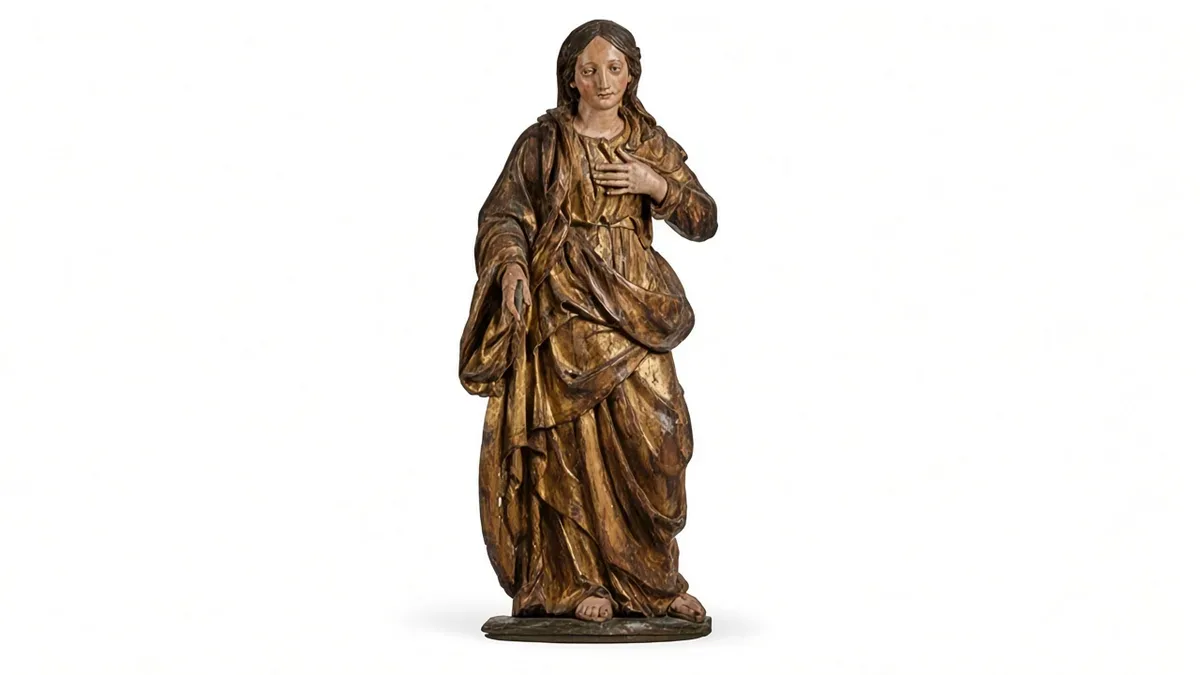
How to Spot a Fake Italian Wooden Saint by Wood and Paint
How to spot a fake Italian wooden saint: construction, paint and later copies, with verified auction prices for period Italian polychrome figures.
A wooden saint that reaches the auction room is almost never signed. The question is not whether the object is wood. It is whether the carving, the paint system and the attributes belong to an Italian church workshop of the sixteenth to eighteenth centuries, or to a later Val Gardena church statue, a plaster cast, a Lecce cartapesta processional figure, or a dressed manichino assembled for Holy Week.
Madonnas and crucifixes are separate types, treated in the guides to Italian wooden Madonnas and Italian wooden crucifixes. What follows is the standing or seated saint: Franciscan, bishop, martyr, evangelist. Construction and paint are evidence of date and of genuineness. They are not a romantic story about the object.
What determines value
Maker or workshop. Named Neapolitan wood sculptors of the late Baroque, above all Giacomo Colombo (Este 1663–Naples 1730, as Gennaro Borrelli set him out in the Dizionario Biografico degli Italiani), move the price when a figure can be tied to a signed or documented work. Treccani records Colombo in marble, polychrome wood and stucco, with church saints sent across the former viceroyalty: a Saint Vitus of 1706 for Salerno, a signed Saint Andrew of 1706 at Gricignano di Aversa, a Saint Catherine signed and dated 1718 at Santa Lucia di Serino. An unsigned “Neapolitan Baroque saint” without that documentary net is a different object. Southern Italian workshops around Diego da Careri in the mid-seventeenth century, recorded on BeWeB for a carved, painted and gilded Saint Francis (about 150 × 70 × 40 cm), belong to the same regional trade. Gardenese export names of the nineteenth and twentieth centuries (Ortisei, Santa Cristina) belong to another.
Period. A hollowed late-medieval or Renaissance figure, even fragmentary, is scarcer in the rooms than an eighteenth-century standing saint of a metre. Scarcity does not always mean a higher hammer. Finarte’s northern Italian fourteenth-century saint of 164 cm, with defects and losses, sold in Rome in 2022 for a four-figure premium price. Unsigned seventeenth-century Franciscans of similar height in Milan have hammered in the same band.
Region. Lombardy, the Kingdom of Naples, central Italy and Sicily used different timbers and different facial types. Limewood (tiglio) is the usual fine timber in Sicily and in Val Gardena; walnut and poplar appear in Tuscany and central Italy. The Cleveland Museum of Art’s reliquary bust of Saint Louis of Toulouse, given as Tuscany, Siena, is walnut with polychromy, gesso and gilding, hollowed from a single block, the cavity closed at the back with added pieces; dendrochronology of the outer measurable ring dates after 1372. A Sienese Gothic bust and a nineteenth-century Ortisei bishop are not interchangeable on the word “Italian.”
Material. Period church saints are carved wood with a gesso ground, paint, and often water gilding over bole. Cartapesta (laminated paper over a core), used in Lecce and the Salento for processional Misteri from the nineteenth century, is lighter, sounds dull when tapped, and is a later industry. Plaster and composition casts of wooden types exist. Glass eyes, real hair and fabric vestments mark the Neapolitan dressed figure, related to but larger than eighteenth-century presepe pastori. They are not proof of 1650.
Rarity. A saint with a readable attribute (Catherine’s wheel, Roch’s plague sore and dog, a Franciscan cord of three knots) and an unrestored paint film is uncommon. Generic “female saints” with lost hands, the usual state in the rooms, are not.
Condition. Lost fingers, split bases, woodworm, and paint losses are normal. They cut the price when structure is unsound. They do not, by themselves, prove age. Fresh worm dust, a collapsed hollow, or a break through the neck that has been dowelled without old glue staining, needs a conservator before a bid.
Restoration. Church images were functioning objects. Oil campaigns of the nineteenth century sit over original gesso; faces were “sweetened.” Complete modern polychromy, replaced hands in a different timber, and a new plinth should be stated. A figure stripped to raw wood is not “more authentic.” It has lost the paint that dated it.
Provenance. A parish inventory, a diocesan photograph, or a documented deaccession is rare in trade. Most lots are “private collection.” Church property in Italy can raise export and tutelage questions that go beyond identification. A reliquary bust with an open theca is a liturgical container, not a mantel ornament.
Size. Height is the first number in the catalogue. Processional saints of 120–160 cm and cabinet figures of 40–70 cm occupy different markets. Weight relative to size is a quick check for cartapesta or a hollow versus a solid later block.
Market demand. London and New York absorb named or early pieces. Italian houses (Il Ponte, Finarte, Bertolami, Cambi, Pandolfini, Wannenes) take the unsigned Baroque saints that furnish interiors. Alpine rooms (Dorotheum) catalogue Lombard and northern Italian figures beside South German limewood, which confuses buyers who read “polychrome wood saint” as a single price. The figures below are results for those lots. They vary with condition and with the room. They are not a valuation of any other statue.
Prices at auction
Verified results, currency as published.
Dorotheum, Vienna, 4 June 2020, Furniture, Porcelain, Sculpture and Works of Art, lot 1025. Saint Catherine, northern Italy, Lombardy, eighteenth century. Carved wood, hollowed on the back, polychrome painted and gilded, height 104 cm, age-related damage, paint losses, one toe damaged. Realised EUR 3,840 including buyer’s premium and VAT (estimate EUR 4,800–5,000).
Il Ponte, Milan, 24 March 2026, sale 762, lot 62. Seventeenth-century sculptor, Franciscan saint, carved wood, painted, gilded and silvered, on a square base, height 132 cm, defects and restorations. Hammer EUR 1,400 (estimate EUR 1,500–2,000).
Bonhams, London, New Bond Street, 7 July 2010, Fine Continental Furniture, Sculpture and Works of Art, lot 11. Italian sixteenth-century carved wood, polychrome decorated and gilded figure of an Evangelist, seated with a book on his lap, lacking forearms and ends of feet, height 89 cm. Sold for GBP 3,840 including premium.
Finarte, Rome, Charms of Art, 20–21 September 2022. Polychrome wooden sculpture of a saint, northern Italy, fourteenth century, height 164 cm, defects and losses. Sold EUR 1,792 including buyer’s premium (estimate EUR 1,300–1,800).
Christie’s, 25 February 2014. Italian carved wood and polychrome figure of a female saint, seventeenth century, flowing dress, curled hair, domed base, height 87 cm. Price realised GBP 2,000 (estimate GBP 2,000–3,000). Christie’s realised prices include buyer’s premium.
Christie’s New York, 17 April 2024, A Park Avenue Collection, sale 23048, lot 139. Pair of Italian parcel-gilt polychromed figures of saints, seventeenth century, each holding aloft torchieres, height 86.4 cm each. Provenance: anonymous sale, Christie’s New York, 6 June 1984, lot 186. Price realised USD 1,512 (estimate USD 3,000–5,000).
Il Ponte, Milan, 13 February 2018, sale 412, lot 392. Neapolitan manufacture, figure of a bishop, wood and cartapesta with fabric vestments and strass, height 61 cm, defects. Hammer EUR 120 (estimate EUR 120–150).
A working picture supported by those results, not a valuation: unsigned Italian polychrome wood saints of about 80–130 cm, with losses, commonly hammer or realise in the low thousands of euros or pounds in Milan, Vienna, London and New York. A large early fragment can sit in the same band as a complete eighteenth-century figure. Dressed cartapesta or fabric bishops of half a metre are a different, cheaper class. A pair of decorative torch-bearing saints can sell below estimate when the room is furniture, not sculpture. Condition and the catalogue’s geographic label still decide each lot.
Authentic or later
Construction first, style second. Medieval and many later Italian figures are hollowed from the back to remove the pith and limit cracking. The Madonna di Acuto in Palazzo Venezia, discussed in the 2018 Medievalista corpus of Romanesque polychrome wood in Italy, is walnut, carved from a single piece, the back deeply hollowed. The Cleveland Saint Louis bust shows the same logic: tool marks inside the cavity, textile over the carving, then gesso. A fully closed, sanded, machine-smooth back on a “seventeenth-century” saint is a warning. So is a figure cut from several boards with modern glue lines and no old gesso in the joints.
The paint system is a ground of gesso bound with animal glue, sometimes over linen at the joins of separate hands and heads, then tempera or oil, with water gilding on red or yellow bole where gold was wanted. The V&A’s seventeenth-century Italian reliquary bust, probably of Philip Neri, is catalogued as carved wood with gesso and slight traces of gilding, a cartouche on the breast for the relic. A sprayed, even flesh tone with no craquelure in the gesso, or gold paint instead of leaf, is consistent with twentieth-century church furnishing. Ultra-violet light and a conservator’s microscope separate original azurite or lead-white films from later oil. Pigment analysis supports a pre-modern layer. It does not, by itself, date the carving.
Tool traces. Hand gouges leave facets that change direction in the hair and in the deep folds. A pantograph milling machine, the method Bolzano’s Chamber of Commerce distinguishes from work it certifies as “entirely hand-carved,” repeats identical contours. The Chamber attaches a metal disc and a numbered certificate to sculptures carved entirely by hand in South Tyrol. That mark dates the object to the modern certification scheme. It does not make a Baroque saint.
Val Gardena is later, not fake. Ortisei and Santa Cristina have carved sacred figures since the seventeenth century; the later export trade, including the GARDENA ART origin mark introduced in 1998, produces new saints in lime or maple with workshop labels. A “Baroque” bishop with a paper label from Via Rezia, Ortisei, or with uniformly sprayed polychromy and a closed back, is a church statue of the last century. Dealers who date it to 1720 on the strength of a gilt cope are selling a liturgical look, not a carving chronology. The same valley’s earlier work is a different problem, discussed with Madonnas; unsigned Gardenese saints of 1650–1750 need comparison with museum pieces, not with a tourist catalogue.
Cartapesta and the dressed figure. Lecce workshops (Antonio Maccagnani, Achille De Lucrezi, Giuseppe Manzo’s Reale Laboratorio statuario) modelled processional Christs and saints in laminated paper in the nineteenth and early twentieth centuries. They are authentic as cartapesta. They are not seventeenth-century wood. Neapolitan manichini combine a carved or modelled head and hands with a clothed armature. Fabric, strass and glass eyes are part of that type. Substituting a wooden period head onto a later dressed body, or the reverse, is a common marriage.
Spanish and German confusion. Estofado punch-work in gilding, and South German limewood saints with hollowed backs, sit in the same sales as Italian lots. Dorotheum catalogues Alpine and Lombard figures in one sculpture session. A “Italian or Spanish” hedge in a London catalogue is a warning to read the face, the timber and the paint, not the first adjective.
Typical reproductions and fakes. Plaster or composition casts of wooden types, often heavier than they look and cold to the touch. Newly carved “seicento” saints in bright gold, the gesso still elastic. Attributes (wheels, grids, lilies) glued on to convert a generic monk into a named martyr. Reliquary windows cut into a solid later bust. Fake worm holes drilled in rows, without old flight-hole staining in the gesso.
Common buyer mistakes. Paying seventeenth-century money for a labelled Ortisei saint. Treating losses as proof of age. Dating from the iconography of the habit alone. Ignoring a 1960s Chamber of Commerce plaque. Confusing a terracotta saint with wood under thick gesso. Assuming a glass eye is early. Buying church property without checking whether it can legally leave Italy.
FAQ
Does a hollowed back prove the saint is old?
No. Period Italian figures are often hollowed. Later carvers copy the cavity because catalogues mention it. Look at tool marks inside, old gesso wrapping into the hollow, and whether the back board is a later closure. A clean router hollow with no paint history is not medieval.
Are Val Gardena saints fakes?
No. They are later production, from a documented Alpine carving trade. The fraud is the date, not the place. A twentieth-century Ortisei saint sold as 1720 Naples is miscatalogued.
How can cartapesta be told from wood?
Weight, tap tone, and a broken edge. Cartapesta shows laminated paper fibres, not grain. Processional Lecce figures of the nineteenth century are a separate market from Baroque wood. A mixed wood-and-cartapesta bishop with fabric vestments, as in Il Ponte’s 2018 lot, should be catalogued as that hybrid.
Do named sculptors such as Giacomo Colombo appear at auction often?
Documented Colombo saints remain tied to churches in Campania, Puglia and Abruzzo. Trade figures labelled “circle of Colombo” need comparison with signed works (the 1718 Santa Lucia di Serino Catherine, the 1706 Gricignano Andrew). An unsigned Neapolitan saint of 1700 is still a Neapolitan saint. It is not a Colombo.
A saint that will be insured, exported or offered at a named sale should be seen by a sculpture conservator with a condition report: timber identified, hollow and joins described, paint samples or at least ultra-violet notes on overpaint, losses and replaced parts listed, and any reliquary opening examined. The figures above are auction results for specific lots. They are not an appraisal of any other statue.