
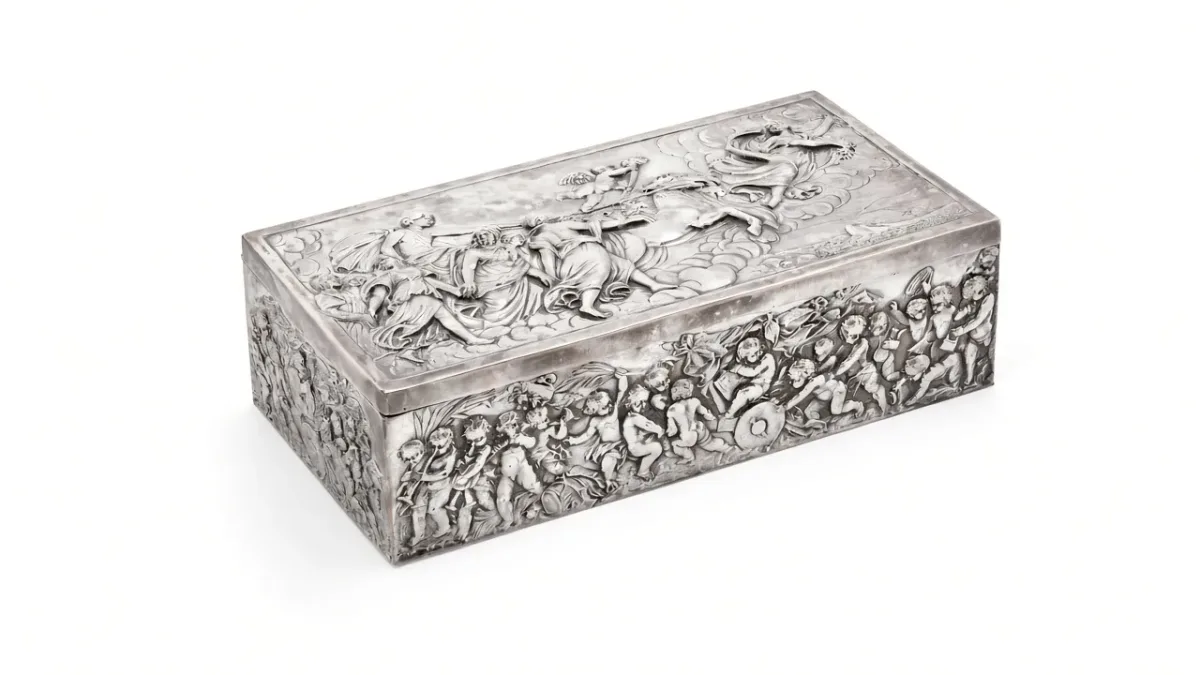
How to Identify an Authentic Italian Silver Box
How to identify an authentic Italian silver box by 800 hallmarks, hinge construction and later copies, with verified auction prices for caskets.
Italian catalogues list the object as a scatola, cofanetto or portagioie: a hinged table box in silver, large enough to hold jewellery, tea, cigarettes or small papers. It is not a pocket snuff box. A tabacchiera sits in the hand. A table box sits on a desk or dressing table, has a piano hinge or a pair of knuckles, and is priced as a small object of vertu, not as table silver sold by the kilo.
Most examples now on the market are twentieth-century Milanese or Vicentine work in 800/1000 silver. Eighteenth-century Italian silver boxes survive; they are scarcer in the rooms than later scatole da tè, cigarette boxes and jewellery caskets. The silver is a raised or die-struck sheet. The interior is often gilt (vermeil). A wooden tray, velvet lining or mastic filling may sit inside. Those additions are included in any published “gross weight.” They are not silver.
The market pays for a named retailer, a readable national mark on both lid and body, an original fitted case, and a hinge that still belongs to the box. It discounts electroplate stamped ARG 800, lids later soldered to older bodies, mixed lots of plate and metal, and boxes whose only “Buccellati” is a later stamp. The figures below are auction results. They vary with condition and the day of sale. They are not a valuation.
What determines value
Maker and workshop come first, and they are not the same thing. Mario Buccellati (Ancona, 1891–Milan, 1965) took over the Beltrami and Besnati shop in Via Santa Margherita, Milan, in 1919. Boxes later sold under that name, or as Gianmaria Buccellati or Federico Buccellati, carry a retailer stamp on the inner rim or flange. The compulsory maker’s mark is a numbered lozenge or star punch of the workshop that actually struck the metal. A name on the cover is a shop. The number is the smith.
Unsigned Milanese and Paduan boxes of the 1930s–1960s trade as silver objects of use. Il Ponte, Milan, 28 March 2025, sale 701, lot 820, sold a shaped silver casket with a red glass cabochon, leaf feet and gilt interior, 18 x 7.5 x 14 cm, 490 g gross, for EUR 330 hammer. The same rooms, 6 May 2025, sale 707, lot 38, sold a floral box by Ganci Carmelo di Giuseppe Morandino, Milan, dated under the base 16 March 1959, 17 x 5 x 9.5 cm, 450 g gross, with defects, for EUR 200 hammer. Fratelli Cacchione of Milan, a later twentieth-century firm, reached EUR 450 hammer at Il Ponte, 5 February 2026, sale 754, lot 481, for a hinged box engraved with a view of old Milan after a print, 13 x 3 x 10 cm, 300 g, with defects. Those three lots set the floor for ordinary Italian table boxes: a few hundred euros when the metal is 800, the marks are local, and there is no famous retailer.
Period and region follow the national hallmark sequence. Law 2 May 1872 made official inspection optional; most boxes of that half-century carry only a stamped 800, sometimes with initials. Law 5 February 1934, n. 305, required an oval fineness punch (800 or 925) and a lozenge with the maker’s number, a two-letter province code and the fasces. Decreto legislativo luogotenenziale 26 October 1944, n. 313, removed the fasces. Law 30 January 1968, n. 46, and D.P.R. 30 December 1970, n. 1496, replaced the lozenge with a polygon and a five-pointed star. A star on a box is not an eighteenth-century mark. It dates the punch, not a revival style chased on the lid.
Material is 800 unless the oval reads 925. Italian table silver was historically 800/1000, not sterling. Buccellati export pieces and some later luxury boxes are 925; Dorotheum, Vienna, 12 December 2025, lot 197, catalogued a Mario Buccellati rectangular box with a raised horse on malachite, 14.5 x 9.5 x 3.5 cm, 670 g gross, marked MARIO BUCCELLATI 925, at EUR 2,080 including buyer’s premium and VAT. Fineness is a floor. Chasing, a named punch and an original case move the price.
Rarity is the named pictorial box, not the generic rocaille casket. Christie's, New York, 2 April 2003, lot 149, sold a rectangular M. Buccellati box with a textured ground and an engraved copper plaque of the Ponte Vecchio, 9½ in. (24 cm), for USD 9,560 realised. Finarte, Milan, 26 June 2023, sold a 925 Buccellati box engraved with the Castelletto at Settimo Milanese, 9 x 6 cm, 143 g, for EUR 2,064 including premium. A view, a motto or a documented gift raises the lot above weight.
Condition is hinge, lock and lid fit. A sprung hinge, a replaced lining, a dented corner or a lid that no longer seats will be noted in Italian catalogues as difetti and will cut the bid. Il Ponte’s Ganci and Cacchione boxes were both catalogued with defects; both sold. Restoration of a lining is expected. Recasting a lid to match a body, or adding a Buccellati stamp to an unsigned 800 sheet, is a different matter.
Provenance is decisive only when it is on the object. Il Ponte, 24 October 2019, sale 459, lot 753, sold a Mario Buccellati rectangular box engraved “Fiume d'Italia - XII settembre - MCMXIX” and “Mastro Paragon Coppella - Orafo del Vittoriale,” with Gabriele d’Annunzio’s signature inside, for EUR 10,500 hammer against an estimate of EUR 2,000–2,200. Il Ponte, 28 March 2025, sale 701, lot 856, sold a small Coppella box inscribed “semper adamas,” 7 x 5 cm, 30 g, with defects and a later family declaration, for EUR 2,200 hammer. Those prices are for a documented D’Annunzio object, not for a table casket. Cambi, Milan, has catalogued a related Coppella box at estimate only; without a published hammer it is not a price.
Size and weight matter less than they do for trays. A large 800 repoussé box can still be a commercial object. Bonhams, Los Angeles, 25 August 2020, sale 26163, lot 19, sold an Italian 800 repoussé box, length 9⅞ in. (25 cm), about 30 oz troy, marked 800, for USD 1,020 including premium. Bonhams, New York, 7 December 2010, sale 18385, lot 1045, sold a larger Buccellati oval covered box chased with acorns and oak, pale stones on a stippled ground, gilt interior, 10 in. (25.3 cm) long, about 34 oz troy, for USD 2,440 including premium. The name and the chasing, not the ounces, doubled the result.
Market demand is for Buccellati tea caddies, bonbon boxes and jewellery caskets with an original case; for Milanese 800 boxes with a city view; and, at the historicist top, for mixed-media caskets with a goldsmith’s signature. Demand is weak for unsigned rocaille caskets, for plate, and for boxes whose wooden core outweighs the silver skin. Dorotheum, Vienna, 22 November 2016, lot 263, sold a square Italian 925 lidded box, height 9.5 cm, 605 g, with a furnished interior, for EUR 1,000 including premium and VAT: a mid-market object, not a masterpiece.
Pre-unification boxes are a separate field. Florentine assay and Neapolitan workshop marks belong on eighteenth-century work. They do not appear on a 1950s portasigarette. The Tesoro dei Granduchi at Palazzo Pitti, formerly the Museo degli Argenti, is the public collection against which a claimed grand-ducal casket has to be judged. Those objects are museum pieces. They are not the lots in a Friday silver sale.
Prices at auction
Unsigned or locally marked Italian 800 table boxes at Il Ponte in 2025–26 have hammered between EUR 200 and EUR 450 for single objects of 300–490 g. A cigarette box signed M. Buccellati, 9 x 6 cm, 140 g, with the arms of Alessandria and the motto “Deprimit elatos levat alexandria stratos,” made EUR 500 hammer at Il Ponte, 25 October 2024, sale 675, lot 770, with minor defects.
Named Buccellati boxes at Finarte, with premium included, sit higher. A jewellery box signed M.BUCCELLATI, curved, on four curled feet, lid centred by a carved coral plaque, 16 x 13 x 4 cm, 388 g, sold at Finarte, Milan, 30 October 2024, for EUR 903 including premium. A tea caddy, c.1950, shaped body engraved with scrolls, foliage and vine, 10.5 x 9.5 x 7.3 cm, 334 g, sold at Finarte, Milan, 27 April 2026, for EUR 1,143 including premium. An octagonal bonbon box with the motto “Faire Sans Dire,” 18 x 18 x 6 cm, 836 g, sold in the same Finarte sale for EUR 2,286 including premium.
English and American rooms confirm the split. Bonhams, Knightsbridge, 10 December 2014, sale 21692, lot 14, sold a twentieth-century Italian silver-gilt, diamond and lapis lazuli trinket box, stamped 800 with distorted Milan marks, 12 cm long, for GBP 2,000 including premium. Christie's 2003 Ponte Vecchio box at USD 9,560 remains an outlier for pictorial work with a copper plaque. D’Annunzio–Coppella boxes at EUR 2,200 and EUR 10,500 hammer are provenance lots.
Dorotheum’s 9 December 2026 online silver sale has catalogued two M. Buccellati 800 lidded caskets of c.1930/40 at estimate only (EUR 4,000–6,000 and EUR 1,000–1,500). Estimates are not hammers.
These figures describe sales of specific lots. A box in different condition, with a replaced hinge or without a case, will not match them. They are not an appraisal of any object in hand.
Authentic or later
Marks first. Lift the lid. The oval 800 or 925 and the maker’s lozenge or star should be struck on the body and, on a well-finished box, repeated on the lid flange. A lid with no mark on a marked body is a warning. A body marked 800 and a lid marked ARG 800 is plate mixed with silver. Specialist catalogues treat ARG 800, ARG 1000 and similar letter stamps as electroplate, not as solid silver.
The 1934–1944 lozenge with fasces, the 1944–1968 lozenge without it, and the post-1968 star polygon date the punch. A box chased in a “Baroque” rocaille, with putti on the lid and a star punch on the base, is a twentieth-century object in a historicist style. It is not an eighteenth-century Genoese casket. Kingdom of Italy assay with 800, as on the Dorotheum Buccellati caskets of c.1930/40, belongs to that same national system.
Construction second. A table box has a continuous piano hinge or two silver knuckles soldered to lid and back. The solder should be the same colour as the body and should show age in the same degree. A steel hinge, a brass pin, or a hinge soldered with a bright modern alloy under an old lid is a later marriage. Wooden cores and velvet trays are original on many Milanese caskets; they should be declared in the weight. Decreto legislativo 22 May 1999, n. 251, requires an R in a square on objects filled with mastic or resin. An older box may have an undeclared wood block. Weigh it against the dimensions. A 18 cm casket at 200 g is a skin, not a silver box.
Surface third. Buccellati’s workshop vocabulary, as described by the firm and by Sotheby’s technical notes, includes rigato (parallel burin lines), telato (cross-hatching like linen) and segrinato (overlapping lines in several directions, used on silver objects from the 1930s–40s). Segrinato is hand work. It catches the light in short, irregular strokes. A sandblasted or engine-turned “Buccellati style” box from Vicenza or the Far East will show a uniform matte. The inner rim stamp on genuine pieces is usually “M. Buccellati” or a longer flange legend such as “M. BUCCELLATI MILAN, ROMA FIRENZE - MADE IN ITALY 800.” A badly spaced BUCCELATI, a missing city, or a stamp that sits on a file-smoothed patch is a later addition.
Wear and patina sit in the recesses of the chasing, along the hinge barrel, and on the corners of the base. Even polishing that has erased the punch while leaving a bright lid is a dealer’s problem, not a virtue. Glass cabochons, coral plaques and malachite panels should have settings that match the age of the box. A new stone in an old bezel is common and should be priced as such.
Typical reproductions are: electroplated brass caskets with rocaille relief and an 800 stamp added in the last twenty years; unsigned 800 boxes given a Buccellati case; cigarette boxes assembled from a marked lid and an unmarked body; and “antique Italian” boxes whose only Italian feature is a later MI or VI punch on imported metal. Common buyer mistakes are to read a star punch as an old town mark, to confuse a photograph frame mount with a box, to treat gross weight as silver weight, and to pay Coppella-level money for an unsigned tea caddy.
A pocket snuff box with a city view is a different object, with its own marks and its own market. Do not date a 9 x 6 cm cigarette box by the rules used for a 1750 Genoese tabacchiera.
FAQ
Is 800 silver on an Italian box “real silver”?
Yes. 800/1000 is the historic working standard for Italian hollow-ware. It is not sterling. It is not plate. Price it as 800, not as 925.
Does a Buccellati stamp guarantee the workshop?
No. The retailer stamp is one mark. The numbered provincial punch is the maker. Both should be present, consistent with each other, and struck before the lining was fitted. Treat a name on a case as marketing until the punches agree.
How can I tell a 1930s historicist casket from an eighteenth-century one?
Read the punch. Fasces, empty lozenge or star means 1934 or later. Pre-unification work carries city assay: Florentine grand-ducal marks, Neapolitan NAP, Venetian lion, and so on. Style of putti and rocaille is not a date.
Why do some genuine boxes have only “800”?
Because official inspection was optional from 1872 until 1934. A bare 800, sometimes with initials, is typical of that period. It is not, by itself, a fake.
Should I buy a box catalogued with difetti?
If the defects are a tired lining, light dents or a stiff hinge, Italian rooms still sell them, as the Ganci and Cacchione lots show. If the defect is a replaced lid, a mixed plate mark, or a name stamp on a filed rim, walk away or price it as plate.
A box with a claimed eighteenth-century city mark, a Buccellati attribution, a mixed-media mount (coral, malachite, lapis, diamonds) or a provenance inscription should be seen by a silver specialist before money changes hands. Ask for a written condition report that photographs the punches on lid and body, describes the hinge and any lining, and states whether the published weight is gross or silver. That report is a description of the object. It is not a price.