
Giacomo Bongiovanni Terracotta Figurines of Caltagirone
How to identify authentic Bongiovanni-Vaccaro terracotta figurines from Caltagirone, read the 1862 workshop marks, and what cobbler groups sell for.
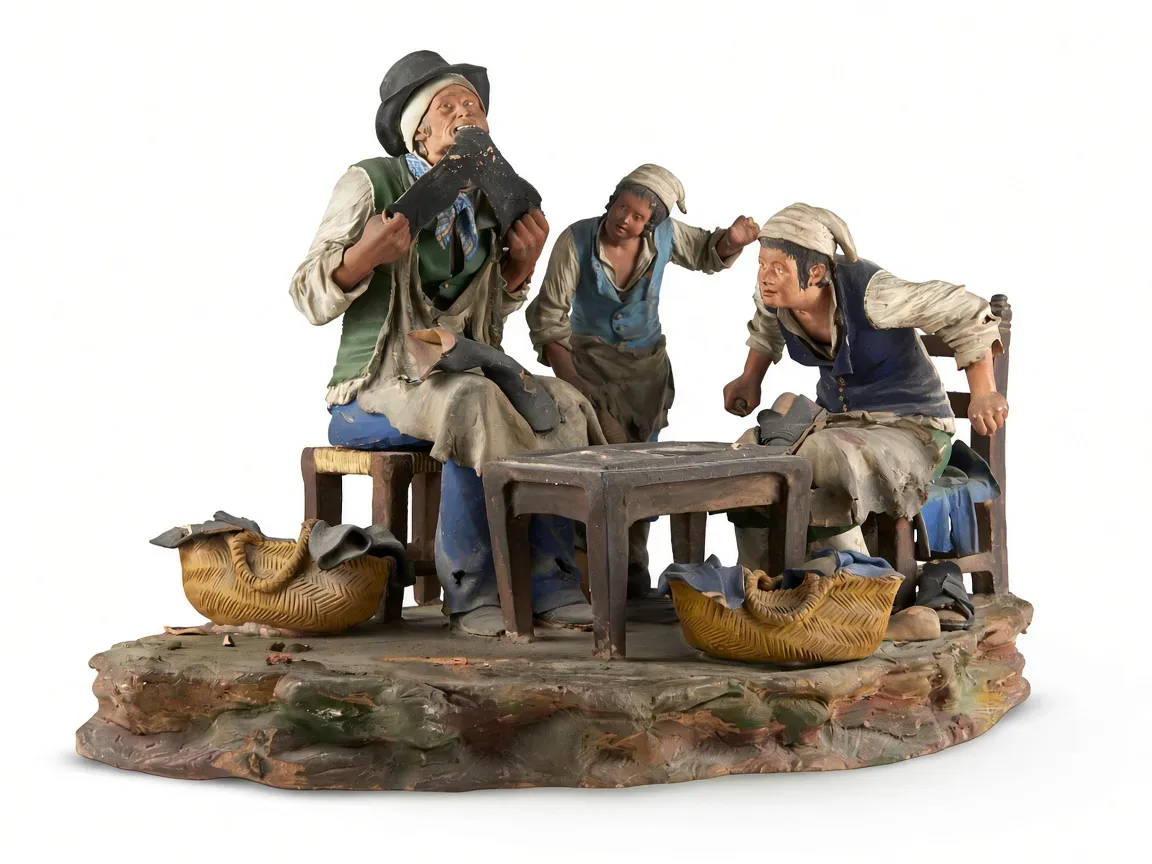
Giacomo Bongiovanni modelled Sicilian street life in fired clay. He was not a maiolica painter. The objects that carry his name are small terracotta groups, usually 25 to 40 centimetres across, coloured in tempera and oil, with drapery built from thin sheets of clay laid over a nude core. Collectors meet them as cobblers, fruit sellers, peasants at table, nativity shepherds and quarreling women. The market still uses one workshop name for two generations: Bongiovanni-Vaccaro of Caltagirone.
This is a workshop study of that bottega, from the shop Giacomo opened in 1794 to the death of his nephew Giuseppe Vaccaro Bongiovanni in 1889. Identification rests on clay, drapery and inscription. Value follows from subject, completeness and condition. The glazed vases, teste di moro and the older albarello trade for which Caltagirone is now known are a different craft from these figurines.
Giacomo Bongiovanni, 1772–1859
Antonino Ragona’s entry in the Dizionario Biografico degli Italiani is the base document. Giacomo was born in Caltagirone on 20 July 1772, son of Bernardo Bongiovanni and Agata Lajacona, both tailors. His elder brother Salvatore taught him to model terracotta figurines. Salvatore left for Rome when Giacomo was fourteen. The shop opened in 1794.
Ragona records that Giacomo could not write his own name. Signed bases are therefore not his autograph. They belong to the later workshop language of the nephew, to a shop label, or to a later addition. That fact matters more than any dealer’s “signed by the master.”
The technical change Ragona isolates is the drapery. Traditional Sicilian figurines were modelled as a single mass. Giacomo cut thin leaves of clay, as a tailor cuts cloth, and laid them on bodies already modelled nude, so that sleeves, aprons and trousers read as garments. He had seen, in the convent of San Bonaventura of the Reformed Friars at Caltagirone, presepe figures by Giovanni Matera of Trapani dressed in real fabric stiffened with glue. The clay sheets are an answer to those cloth costumes. They remain the first test on a group offered as Bongiovanni.
Subjects came from the town: gossip at the cobbler’s and the barber’s, blind beggars, itinerant musicians, peasants riding home on donkeys, questing friars, brawls among women. Colour was tempera and oil, matched to costume. He also modelled shepherds for the crib, using the same country types. He died in Caltagirone on 6 December 1859 and was buried at San Bonaventura.
Museum holdings that can be used as a control set sit in the Museo Regionale della Ceramica at Caltagirone: a Nativity, the cobbler’s shop (Bottega del Ciabattino), a zampognaro, and the blind musicians. Further groups are recorded, per Ragona, in Palermo’s then Museo Nazionale and in Syracuse. A civic portrait of Giacomo, voted in his lifetime, was the occasion, in 1856, on which he handed the annual terracotta gifts to the municipality over to his nephew.
Giuseppe Vaccaro Bongiovanni, 1809–1889
Giuseppe was the son of Giacomo’s sister. Ragona gives the birth year 1809. The tomb slab placed by the comune of Caltagirone records 23 June 1809 to 28 November 1889, and names him Giuseppe Vaccaro Bongiovanni. From the 1840s the shop is Bongiovanni-Vaccaro. Bases may read Gia-Giu Bongiovanni Vaccaro, Bongiovanni Vaccaro da Caltagirone, or G.V.B.
Ragona warns against mixing the two hands. Giuseppe kept the clay-sheet drapery and widened the repertory to bourgeois and aristocratic sitters, historical groups and, later, mythological figures. Luca Mansueto’s 2017 study in Faenza treats the shop as three names: Giacomo, Giuseppe, and Giuseppe’s son Giacomo Vaccaro, working through the second half of the nineteenth century while Caltagirone’s floor-tile maiolica lost ground to Neapolitan and Vietri imports.
A repeating inscription on oval bases reads, in substance, Bongiovanni Vaccaro da Caltagirone, premiata nella Universale Esposizione di Londra 1862. Giacomo had been dead for more than two years when that exhibition opened. The line is a workshop claim of Giuseppe’s generation. It is not a date of modelling for 1794–1859, and it is not proof that Giacomo sent a crate to South Kensington.
The Museo Miniscalchi-Erizzo in Verona holds nativity figures catalogued to Giuseppe, including a photographed workshop mark, and describes the same overlapped clay strips. Those crib figures sit in a different collecting field from the Neapolitan presepe of wood, tow and stucco. Caltagirone groups are solid terracotta, usually on a shared rocky base, not articulated mannequins.
What determines value
Maker and generation come first. A group that can be held to Giacomo’s folk repertory and clay-sheet method, with museum-quality modelling of faces and hands, is the scarce end of the shop. Giuseppe’s signed and inscribed output is larger and more often seen at Italian auction. Later Caltagirone figurinai, and “manner of” lots, sit below both.
Period follows from that distinction. Pre-1859 groups without the 1862 London line are the ones specialists argue over. Post-1862 inscribed pieces are workshop of Giuseppe or his sons. Twentieth-century tourist figurines in the same attitudes are another object class.
Region is Caltagirone, in the province of Catania. Pink-orange local clay, visible in losses and on the underside, is consistent with that source. White or grey bodies, plaster, or fully glazed undersides are not.
Material is fired terracotta with tempera and oil, not tin-glazed maiolica and not porcelain. A shiny tin glaze over a figurine is the wrong technique for this shop. Compare that surface with later Italian terracotta sculpture, where casts and plaster skins are the usual substitutes.
Rarity is a function of subject and completeness. Multi-figure genre groups (the cobbler, the tooth-puller, peasants at a meal) are the catalogue types. Isolated shepherds and single vendors are commoner. Missing heads, replaced baskets and truncated bases cut value faster than honest paint loss.
Condition is expected to be imperfect. Auction notes on genuine groups almost always list difetti e mancanze: lost fingers, chipped hat brims, flaked colour on knees and table edges. Overpaint that hides those losses is a defect. A mint, evenly sprayed surface is a warning, not a premium.
Restoration should be disclosed. Filled chips in the clay, new paint on faces, and replaced wooden plinths are normal. A later veneered oval base, as on some inscribed cobbler groups, is a mount, not part of the original clay.
Provenance helps when it is a named Sicilian collection or an old expertise. Gennaro Borrelli’s 1988 notes, cited on Il Ponte lots from a single property, are the sort of paper that supports a high hammer. A tourist receipt from Caltagirone does not.
Size clusters around 30 to 40 centimetres in the largest dimension for groups, and about 30 to 36 centimetres high for standing single figures. Monumental urns and allegorical busts catalogued under the later family name are a different typology and should not be priced off figurine results.
Demand is Italian and specialist. The cobbler (Il calzolaio / Dal calzolaio) is the recognisable type, which is why it repeats in the sale rooms. Foreign “manner of” boxes of eight small figures sell as decoration, not as the shop.
Prices at auction
The figures below are published hammers or, where stated, prices including premium. They are not a valuation. Condition, subject and the day’s room decide the next lot.
Il Ponte, Milan, 9 April 2019, sale 445, lot 29: workshop of Vaccaro Bongiovanni, Caltagirone, 19th century, Il calzolaio, terracotta group 37 × 27 × 22 cm, inscribed Bongiovanni Vaccaro da Caltagirone, premiata nella Universale Esposizione di Londra 1862, veneered wooden base, losses. Hammer EUR 2,200 against an estimate of EUR 1,400–1,500.
Same sale, lot 31: workshop of Vaccaro Bongiovanni, genre scene, terracotta 41 × 27 × 20 cm, the same London 1862 inscription, wooden base, losses. Hammer EUR 1,900 against EUR 1,400–1,500.
Il Ponte, 13 October 2020, sale 489, lot 164: workshop of Bongiovanni Vaccaro, Caltagirone, 19th century, Contadini in sosta che consumano un pasto, polychrome terracotta 40 × 35 × 25 cm, fragment of a paper label …In Caltagirone, defects, with a 1988 expertise by Gennaro Borrelli. Hammer EUR 4,000 against EUR 4,000–4,500. The cataloguer’s “Giovanni Bongiovanni” is a slip for Giacomo; the Treccani entry cited in that note is Ragona’s life of Giacomo.
Same sale, lot 167: workshop of Bongiovanni Vaccaro, Il cavadente (tooth-puller), polychrome terracotta 27.5 × 33.5 × 19 cm, inscribed Bongiovanni Vaccaro Caltagirone Premiata nella Universale Esposizione di Londra 1862, catalogued toward Giuseppe Vaccaro Bongiovanni (Caltagirone 1809–1888?). Hammer EUR 2,400 against EUR 2,500–3,000.
Il Ponte, 25 March 2026, sale 762, lot 185: workshop of Bongiovanni Vaccaro, Caltagirone, 19th century, Dal calzolaio, polychrome terracotta nativity/genre group 40 × 28 cm, defects. Hammer EUR 1,800 against EUR 1,600–1,700.
Same sale, lot 179: workshop of Bongiovanni Vaccaro, Figure femminili con bambini, polychrome terracotta 25 × 36 cm, defects. Hammer EUR 650 against EUR 450–500.
Same sale, lot 195: Giuseppe Vaccaro and Giacomo Bongiovanni, 19th century, pair of fruit sellers, polychrome terracotta, signed on the bases, maximum height 34 cm, defects. Hammer EUR 1,100 against EUR 550–600.
Same sale, lot 207: Giuseppe Vaccaro and Giacomo Bongiovanni, 19th century, three nativity figures (La Portalegna, Il Venditore di polli, Il Mendicante), polychrome terracotta, signed on the bases, height 36.5 cm, defects. Hammer EUR 1,000 against EUR 650–700.
Austin Auction Gallery, 21 June 2025: eight Italian terracotta figures catalogued as “manner of” Giuseppe Vaccaro and Giacomo Bongiovanni, largest about 22.5 cm high. Hammer USD 150, USD 191 including premium. That is the decorative floor, not the shop.
Taken together, documented Caltagirone workshop groups in the 30–40 cm class have recently sold between about EUR 650 (small or damaged figural groups) and EUR 4,000 (a complete meal scene with old expertise). Inscribed cobbler and tooth-puller groups have clustered around EUR 1,800–2,400 hammer. Single signed fruit sellers and shepherds, sold as pairs or threes, have made about EUR 1,000–1,100 the lot. Prices move with paint, missing hands and whether the cataloguer will say workshop rather than manner of.
Wannenes has catalogued a late-nineteenth-century peasant woman of Vizzini, height 33.5 cm, inscribed G.V.B. and the London 1862 line, with a reference to Ragona’s Terra Cotta. La cultura ceramica a Caltagirone (Catania, 1991). The published figure there is an estimate, not a hammer, and is not used as a price.
Authentic or later
Start with the clay. Caltagirone figurines are terracotta, pink to orange where the paint has gone. The underside of the base is usually raw clay, not a white glaze. Plaster, resin, and hollow slip-cast bodies are later. A magnet does not help; weight and a chip in an unseen place do.
Then the drapery. Authentic workshop figures show overlapping clay leaves with cut edges at cuffs and hems. Folds are thin and crumpled, not thick rolls modelled in one lump. Smooth, identical drapery on a set of eight “shepherds” is mould work.
Faces are the shop’s argument. Open mouths, asymmetric wrinkles, and eyes that do not match are typical of Giacomo’s folk types. Doll-pretty faces with even lashes are not. Giuseppe’s bourgeois sitters are calmer, but the clay sheets remain.
Inscriptions need a date check. Gia-Giu Bongiovanni Vaccaro and G.V.B. are workshop marks of the joint and later shop. The London 1862 prize line cannot belong to Giacomo’s lifetime. A base that adds that line in fresh paint, in a round commercial script, on an otherwise earlier-looking group is a later label. Giacomo’s own pieces, if they survive unsigned, are identified by modelling, not by a signature he could not write.
Polychromy is tempera and oil, worn at projections. Even spray, polyurethane gloss, and colour that sits on top of dirt are repaint. Complete loss of colour on an otherwise sharp group does not by itself make a fake; Il Ponte has sold unpainted or stripped cobbler groups with the 1862 inscription. It does change the price.
Typical later objects: twentieth-century Caltagirone gift-shop figurines in the same peasant attitudes, often fully glazed in bright maiolica colours; plaster crib figures sold as terracotta; mixed lots catalogued “manner of Vaccaro and Bongiovanni” at provincial sales; and groups with replaced modern baskets glued to an old base.
Common buyer mistakes are to treat every Caltagirone figurine as Bongiovanni, to read the 1862 inscription as a date of 1862 for the clay, to confuse these solid terracotta groups with Neapolitan presepe mannequins, and to pay a shop price for a manner-of box. Another is to ignore losses. Fingers, hat brims and basket handles go first; a group described as perfect at a high estimate should be looked at in the hand.
FAQ
Did Giacomo Bongiovanni sign his terracotta groups?
Ragona states that he could not write his name. Surviving signatures and the London 1862 inscription are workshop language from Giuseppe Vaccaro Bongiovanni and the later shop, not Giacomo’s autograph.
How do Caltagirone figurines differ from Neapolitan presepe figures?
Caltagirone Bongiovanni-Vaccaro groups are fired terracotta on a shared base, with clay-sheet clothes. Eighteenth-century Neapolitan crib figures are mixed media: modelled heads and hands, tow bodies, real textiles. The two traditions share street types and should not share a price list.
What is a fair auction range for a cobbler group?
Verified hammers for inscribed or workshop cobbler groups at Il Ponte run from EUR 1,800 (sale 762, lot 185, March 2026) to EUR 2,200 (sale 445, lot 29, April 2019). Smaller or more damaged figural groups in the same rooms have made EUR 650. Those results are not an appraisal.
When to seek an appraisal
A professional opinion is warranted when a group is offered as Giacomo rather than workshop, when an 1862 inscription has been added to a piece claimed as late eighteenth century, when polychromy has been entirely renewed, or when the price sits well above the Il Ponte cluster recorded here. A written condition report should list losses to clay, overpaint, and whether the wooden plinth is original. For insurance or a contested attribution, use a specialist in Sicilian ceramics or presepe sculpture, not a generalist valuation of “Italian terracotta.”